Last updated 2026-07-24
TL;DR
Yes. Once mixed with bacteriostatic water, sermorelin must be refrigerated at 36-46°F (2-8°C) and used within about 14 to 30 days depending on the pharmacy's stability data. Unmixed (lyophilized) powder is more stable and some formulations can sit at room temperature short-term, but refrigeration before and after reconstitution is the safe default.
Does sermorelin need to be refrigerated?
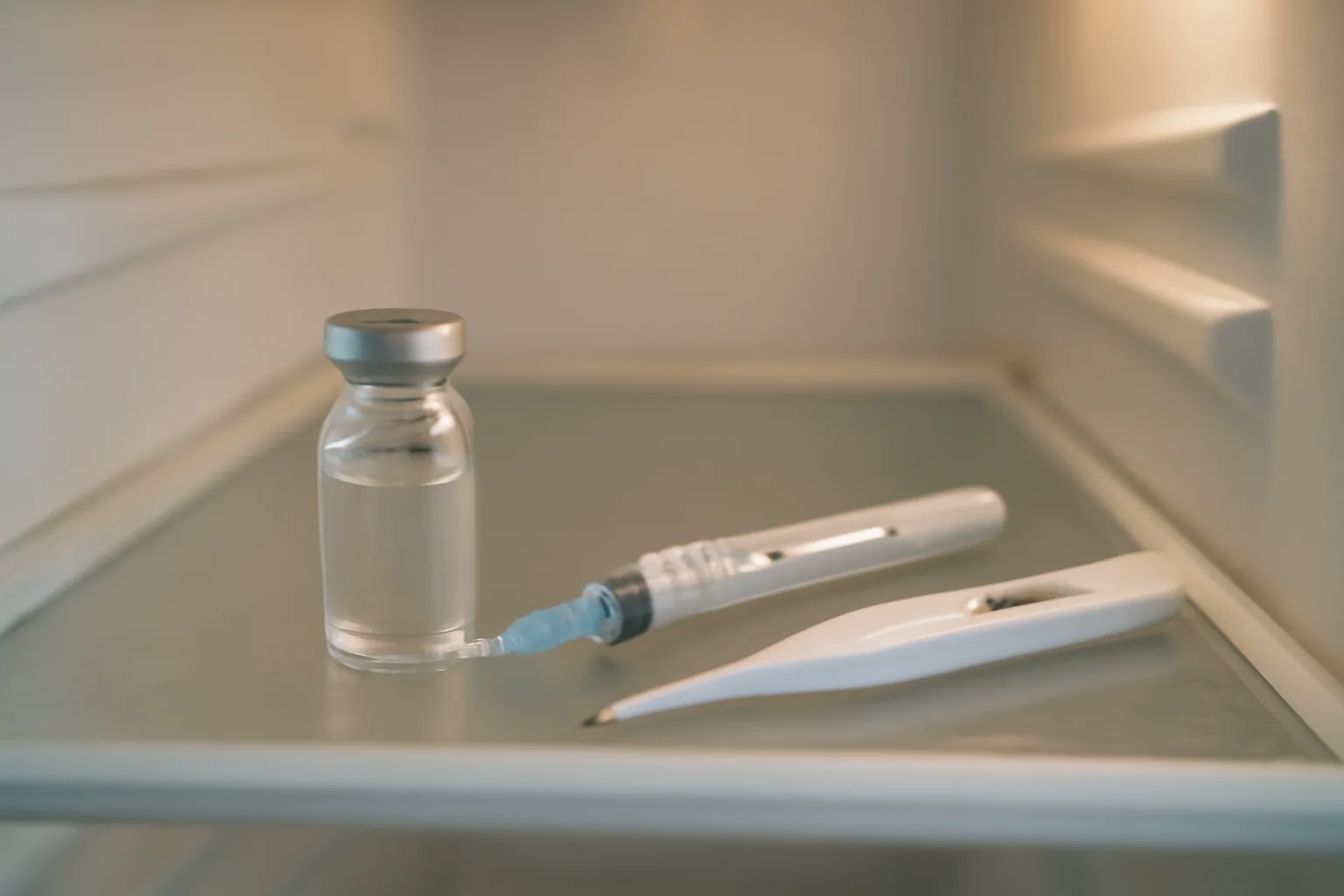
Short answer: yes, once it's been mixed into a liquid. Sermorelin acetate is shipped and stored as a freeze-dried (lyophilized) powder in a vial. That powder is fairly stable. The moment a pharmacist or patient adds bacteriostatic water to reconstitute it, the peptide becomes vulnerable to degradation from heat, light, and bacterial growth, and it needs to go in the refrigerator, typically between 36-46°F (2-8°C) [1]. This isn't unique to sermorelin. It's standard practice for peptide hormones in general, and it mirrors how the original branded product, Geref, was handled when it was sold in the US. The FDA label for Geref (sermorelin acetate for injection) specified refrigerated storage after reconstitution and a limited use window, which is the same logic compounding pharmacies apply today [2]. If your vial arrived as a dry powder and you haven't mixed it yet, you have more flexibility, but refrigeration is still the safer default until you're ready to reconstitute and begin dosing.
How long does reconstituted sermorelin last in the fridge?
Most compounding pharmacies set a beyond-use date of 14 to 30 days after reconstitution when the vial is kept refrigerated, though some cite up to 28 days specifically. This isn't a single universal number; it depends on the specific pharmacy's stability testing, the diluent used, and the concentration of the mix. The United States Pharmacopeia (USP) General Chapter <795>, which governs nonsterile compounding, and <797>, which governs sterile compounding, set default beyond-use dating limits for compounded preparations when a manufacturer or published stability study isn't available. For a conventionally compounded aqueous formulation stored under refrigeration, the default limit under USP <797> is 9 days unless the pharmacy has its own validated stability data extending that window [3]. Many pharmacies that dispense sermorelin do have supporting data, which is why you'll commonly see 20 or 30 day dating on the label rather than 9. Always follow the specific date printed on your vial. It overrides any general rule you read online, including this one. Once that date passes, the manufacturer's or pharmacy's guarantee of potency and sterility is gone. The peptide may still look and inject the same, but you have no assurance it's still delivering the labeled dose, and using it past date is a judgment call you're making without data.
What temperature should sermorelin be stored at?
Refrigerated, not frozen: 36-46°F (2-8°C) is the range you'll see on most compounding pharmacy labels [1]. A standard kitchen or bathroom refrigerator door shelf runs a little warmer and less stable than the back of a middle shelf, so store the vial toward the back, away from the door. Don't freeze it. Freezing and thawing can damage the peptide structure and isn't part of any standard storage instruction for sermorelin. If a vial accidentally froze, treat it as compromised and don't use it. Before reconstitution, unmixed lyophilized sermorelin is more heat-tolerant. Some manufacturers and pharmacy references note the dry powder can tolerate brief room-temperature excursions (for example, during shipping) without meaningful loss of potency, which is one reason peptide vials can be shipped without dry ice in many cases. That tolerance disappears once water is added.
Can sermorelin be left out of the fridge, even briefly?
Reconstituted sermorelin can typically tolerate short trips out of the refrigerator, like the 20 to 30 minutes it takes to draw up and inject a dose, without a meaningful problem. What it can't tolerate is being left on a counter, in a car, or in a gym bag for hours or overnight. Heat is the main enemy. Peptide bonds break down faster at higher temperatures, and repeated warm-cool cycles accelerate that further. A vial that's been left out for a full day in a warm room should be treated as suspect, even if it looks unchanged. Sermorelin, unlike some medications, doesn't give a strong visual or smell warning when it degrades. Cloudiness, discoloration, or particles are red flags and mean discard the vial regardless of date, but a clear vial past its potency window isn't necessarily fine. If you travel, an insulated bag with a small ice pack for a few hours is reasonable. Dry ice or long-term room-temperature storage during travel is not recommended for reconstituted product.
How should sermorelin be stored before it's mixed (unmixed powder)?
Unreconstituted, lyophilized sermorelin in a sealed vial is the more stable form of the two. Most pharmacy references still recommend refrigerating it, but it's less fragile than the mixed solution and short-term room temperature exposure during shipping generally isn't a crisis. Once it arrives, put it in the refrigerator and leave it there until you're ready to reconstitute. Don't reconstitute more vials at once than you'll realistically use inside your pharmacy's stated dating window. It's tempting to mix a few vials at once to save time, but each mixed vial starts its own clock, and mixing on an as-needed basis keeps more of your supply in the more stable, unmixed state for longer. Keep the original vial box if it has printed lot numbers and expiration information; you'll want that if you ever need to report a problem.
What happens if sermorelin isn't refrigerated properly?
The main risk isn't sudden toxicity, it's silent loss of potency. Peptide hormones like sermorelin degrade through a chemical process (deamidation and hydrolysis of the peptide bonds) that speeds up with heat exposure. A vial stored warm for days may still be sterile and safe to inject, it just may not do much, because a meaningful fraction of the active peptide has broken down into inactive fragments. That's the practical downside: you keep injecting on schedule, don't see the response you expected (better sleep, slow changes in body composition), and can't tell whether it's the compound's biology or a degraded vial. This is one more reason working with a provider who prescribes through a pharmacy with documented storage and stability practices matters more than it might seem. See our sermorelin dosage chart for what a typical, properly stored regimen looks like in terms of timing and expected response window. There's no published human data specifically quantifying how much potency is lost per hour at room temperature for sermorelin; most of what pharmacists rely on is general peptide stability science and the manufacturer's original stability studies for Geref, which specified refrigerated storage as the condition under which potency claims were valid [2].
Does sermorelin need to be refrigerated the same way as HGH?
Yes, largely. Both sermorelin and recombinant human growth hormone (HGH, e.g., somatropin) are peptide-based and reconstituted before injection, and both require refrigeration after mixing, generally in the 36-46°F range with a limited days-to-weeks use window [1][4]. Some somatropin pen systems are approved for a specific number of days at room temperature after first use per their individual FDA labeling, so always check the specific product insert rather than assuming. Where they differ is regulatory oversight, not storage chemistry. HGH products like Norditropin, Genotropin, and Omnitrope are FDA-approved with fixed, tested stability data on their labels. Sermorelin sold today is dispensed through compounding pharmacies, not as an FDA-approved finished drug, so its beyond-use dating comes from the compounding pharmacy's own testing (per USP <795>/<797>) rather than a manufacturer's New Drug Application stability program [3]. That's an important distinction for a reader deciding sermorelin versus HGH more broadly: the storage burden is similar, but the certainty behind the number on the label is not.
Sermorelin versus HGH: which one is actually the better choice?
This is the question most readers researching sermorelin actually want answered, so here's the honest version. Sermorelin is a growth-hormone-releasing hormone (GHRH) analog. It stimulates your own pituitary gland to make and release growth hormone in a pulsatile pattern, similar to your body's natural rhythm. HGH (somatropin) is the hormone itself, given directly, bypassing the pituitary entirely. Because sermorelin depends on a working pituitary, its ceiling effect is real: it can't push growth hormone output above what your pituitary is physiologically capable of producing, and effectiveness declines somewhat with age as pituitary responsiveness drops. HGH has no such ceiling; it delivers a fixed, predictable dose regardless of your own gland's function. That's precisely why HGH is FDA-approved for conditions involving diagnosed growth hormone deficiency and specific wasting syndromes, with dosing tested in clinical trials, while sermorelin's original branded version, Geref, was approved narrowly for diagnostic testing of pituitary GH reserve and for pediatric growth hormone deficiency before being discontinued from the US market for business reasons, not safety findings [2][2]. In practice, that means sermorelin is the gentler, more physiologic option with a lower side effect burden (injection site reaction and transient flushing are the most commonly reported issues) but a softer, slower, more variable effect. HGH is the stronger, more predictable, more studied option for confirmed deficiency, but it comes with tighter monitoring needs and a real risk profile including fluid retention, joint pain, and, per FDA labeling for pediatric use, a boxed warning history related to reports of death in pediatric patients with certain risk factors receiving somatropin, which is a key reason HGH requires active physician oversight [5]. If you don't have a diagnosed deficiency, going straight to HGH is generally the wrong call, both from a regulatory and a risk standpoint. If you do have documented deficiency confirmed through appropriate testing, sermorelin is not really a substitute for HGH; it's a different tool for a different situation. Anyone telling you sermorelin will get you HGH-level results, or that it reverses aging, is overselling weak or absent evidence. Read our page on sermorelin long-term side effects before starting either one.
How can you tell if sermorelin has gone bad?
Look before you inject, every time. Discard the vial if you see cloudiness, visible particles, discoloration (it should be clear and colorless to slightly off-white when mixed), or if the powder before mixing looks caked, discolored, or stuck to the vial in an unusual way. Smell and clarity aren't reliable enough on their own though. A vial can look perfectly normal and still have lost meaningful potency from being stored too warm for too long, which is the sneakier failure mode. That's why tracking your own reconstitution date and refrigeration conditions matters more than trusting a visual check alone. If you're unsure whether a vial was mishandled (a fridge that failed, a package left on a porch in summer heat, a move where cold-chain shipping was delayed), the safest move is to contact the dispensing pharmacy and ask for a replacement rather than guessing.
How is sermorelin shipped, and does that affect storage?
Reputable pharmacies ship sermorelin with cold-chain packaging, meaning insulated containers with ice packs or gel packs, especially in warm months. Lyophilized powder tolerates brief shipping temperature swings better than people assume, but a package left on a doorstep for 8+ hours in summer heat is a legitimate reason to inspect the vial carefully or ask the pharmacy about their handling guarantee. When your package arrives, get it into the refrigerator promptly. Don't let it sit on a counter for the rest of the day because you're busy. This is also a reason to buy through a legitimate, provider-reviewed channel rather than an unregulated online seller with no visibility into their shipping practices; the storage instructions only matter if the product was handled correctly before it reached your door. Sermorelin reviews covers what to look for when vetting a pharmacy or provider on this front, and Sermorelin Co's provider-reviewed pathway routes patients to a fulfilling pharmacy that handles cold-chain shipping and stability dating as a standard part of dispensing, rather than leaving that to chance.
What storage supplies do you actually need at home?
You don't need anything elaborate. A standard refrigerator (not the door shelf, not next to the freezer coils) is sufficient. Some people use a small dedicated container or bin inside the fridge to keep vials, syringes, and alcohol swabs together and away from food, mostly for organization and to reduce the chance of a vial getting knocked over or lost behind other items. A basic fridge thermometer is a genuinely useful $10 purchase if your refrigerator doesn't have a reliable digital display, since home fridges can run several degrees colder or warmer than their dial suggests. Keeping the internal temperature verified in the 36-46°F range removes the guesswork [1]. You do not need a specialized medical refrigerator for home use at typical patient dosing volumes. Those are more relevant for pharmacies and clinics storing larger inventories.
Frequently asked questions
Does unmixed sermorelin powder need to be refrigerated?
It's recommended, though unmixed lyophilized powder is more stable than reconstituted solution and can tolerate brief room-temperature periods, such as during shipping, without major issue. Once you're home, put it in the refrigerator and leave it there until you're ready to mix and begin dosing.
How long can reconstituted sermorelin sit out of the fridge?
Generally fine for the 20-30 minutes it takes to draw up and inject a dose. Beyond a few hours, especially in a warm room, potency loss becomes a real concern. Don't leave a mixed vial out overnight or in a hot car; treat that vial as compromised.
Can sermorelin be frozen for longer storage?
No. Freezing isn't part of standard sermorelin storage guidance and can damage the peptide structure through freeze-thaw stress. If a vial freezes accidentally, the safest choice is to discard it rather than use it after thawing.
How long does a vial of sermorelin last once mixed?
Typically 14 to 30 days refrigerated, depending on the specific pharmacy's stability data and the beyond-use date printed on your label. USP <797> sets a 9-day default for compounded aqueous preparations without pharmacy-specific stability testing, so always defer to the printed date over any general rule [3].
What's the ideal refrigerator temperature for sermorelin?
36-46°F (2-8°C) is the standard range cited on most compounding pharmacy labels. Store the vial toward the back of a middle shelf rather than the door, where temperature swings less. A basic fridge thermometer helps confirm your unit is actually holding that range.
Is sermorelin the same as Geref?
Sermorelin acetate is the active peptide; Geref was its FDA-approved brand name in the US. Geref was discontinued from the market for business reasons, not withdrawn for a safety problem. Sermorelin today is available through compounding pharmacies rather than as an FDA-approved branded product.
Is sermorelin as effective as HGH?
No, not in raw output. Sermorelin stimulates your pituitary to release your own growth hormone, so it's capped by your gland's natural capacity and effects are more gradual. HGH delivers growth hormone directly with no such ceiling, which is why it's the approved treatment for diagnosed deficiency.
Why was Geref discontinued if it wasn't a safety issue?
Manufacturers discontinue products for commercial reasons unrelated to safety fairly often: low sales volume, manufacturing costs, or shifting business priorities. FDA drug discontinuation listings distinguish this from a safety-driven market withdrawal, and Geref's removal falls into the discontinued-for-business-reasons category, not a recall.
Can you travel with sermorelin?
Yes, with care. Use an insulated bag with a small ice or gel pack for trips of a few hours. Avoid leaving vials in checked luggage exposed to temperature extremes or in a hot car. For longer travel, plan refrigerator access at your destination as soon as possible.
Does sermorelin expire?
Yes, in two ways: the manufacturer/pharmacy expiration date on the sealed, unmixed vial, and the shorter beyond-use date that starts once you reconstitute it. The beyond-use date almost always arrives first and is the one that matters for a vial you're actively using.
What does it mean if reconstituted sermorelin looks cloudy?
Cloudiness, particles, or discoloration mean the vial should be discarded, regardless of how many days are left on its beyond-use date. Properly mixed sermorelin should look clear and colorless to slightly off-white. Visual changes signal degradation or contamination and aren't worth the risk of injecting.
Do compounding pharmacies test how long sermorelin lasts?
Reputable ones do, through stability testing that supports the beyond-use date printed on your vial, operating under USP <795> and <797> compounding standards [3]. Less careful sources may default to conservative or even arbitrary dating, which is one reason vetting the dispensing pharmacy matters as much as vetting the prescriber.
Sources
- USP General Chapter <659>, Packaging and Storage Requirements (defines "refrigerate" as 2-8°C / 36-46°F): Refrigerated storage range of 36-46°F (2-8°C) for reconstituted peptide products
- FDA, Geref (sermorelin acetate for injection), NDA 019826 approval history, Drugs@FDA: Geref was FDA-approved sermorelin acetate with refrigerated storage instructions, later discontinued from the market
- USP General Chapter <797>, Pharmaceutical Compounding - Sterile Preparations, beyond-use dating defaults: Default 9-day beyond-use date under refrigeration for compounded sterile preparations absent pharmacy-specific stability data
- FDA label, Norditropin (somatropin) injection, prescribing information storage section: HGH products require refrigerated storage after reconstitution with product-specific use windows
- FDA label, Genotropin (somatropin) prescribing information, boxed warning section: Somatropin labeling has included boxed warning history regarding pediatric patients with specific risk factors
- National Center for Biotechnology Information, StatPearls: Growth Hormone Releasing Hormone (sermorelin) physiology and pharmacology: Sermorelin stimulates pituitary GH release in a pulsatile pattern and depends on intact pituitary function