Last updated 2026-07-24
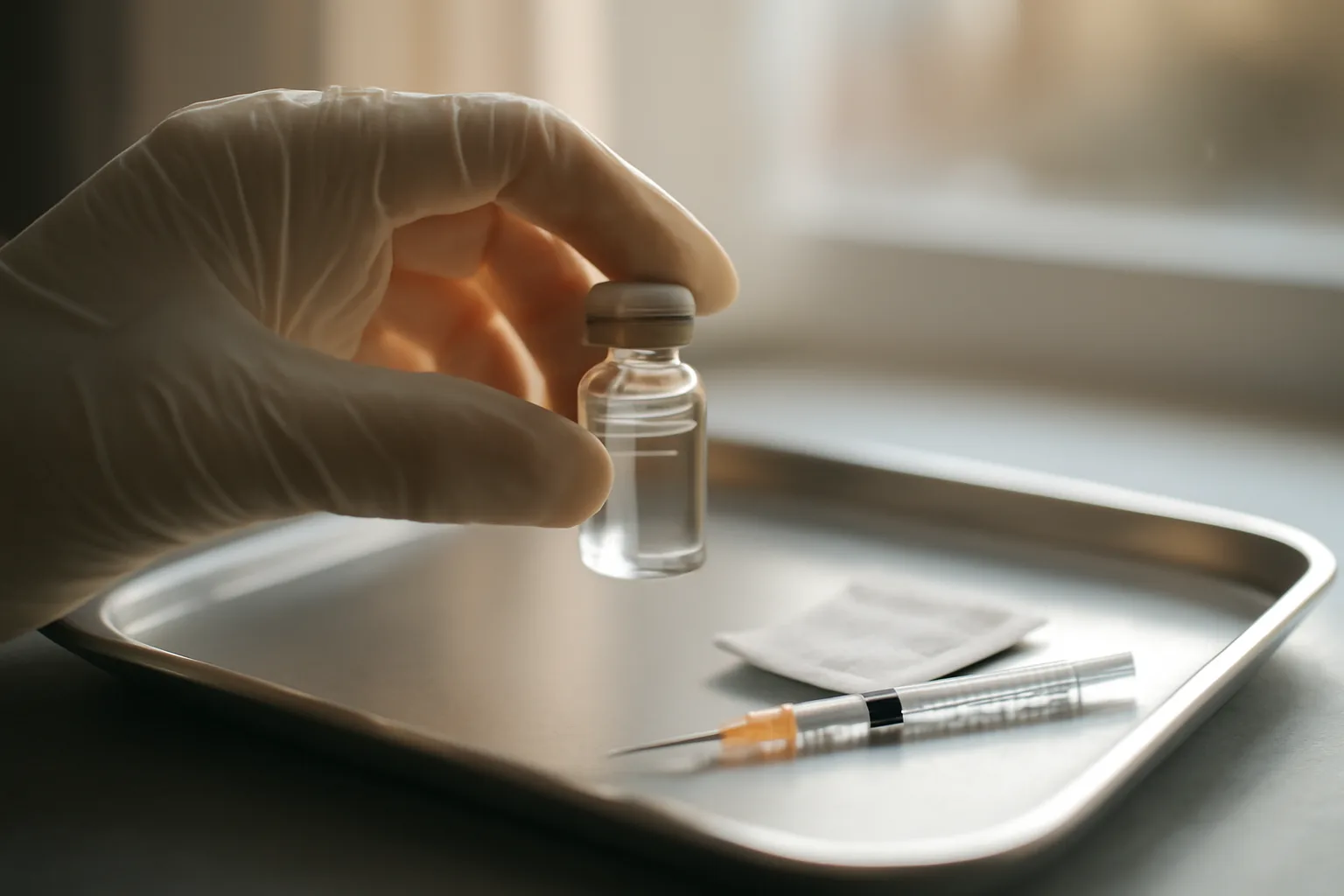
TL;DR
Reconstituting sermorelin means adding sterile (usually bacteriostatic) water to the lyophilized powder, gently swirling (never shaking) until it clears, then refrigerating. Most compounded vials stay stable roughly 2-4 weeks refrigerated once mixed. Your prescribing pharmacy should hand you exact concentration, diluent, and expiration instructions specific to your vial. This piece explains the mechanics; it isn't a substitute for those pharmacy-specific instructions.
what does it mean to reconstitute sermorelin?
Sermorelin ships as a freeze-dried (lyophilized) powder in a sterile vial, not a ready-to-inject liquid. Reconstitution just means adding a sterile liquid, the diluent, back into that powder so it dissolves into a solution you can draw into a syringe. This is standard for a lot of peptide and protein drugs because the peptide is unstable in liquid form over long storage, but reasonably stable as a dry powder. This isn't unique to sermorelin. Growth hormone itself (somatropin) ships the same way, and so do most GHRH analogs studied in the peptide literature, including work on GHRH-related compounds' enzymatic and serum stability that shows how quickly these peptides can degrade once they're in solution [1]. The dry powder buys shelf life; the reconstituted vial does not have nearly as much. A sermorelin vial you get from a compounding pharmacy is not an FDA-approved drug product like the original brand-name Geref was. Geref (sermorelin acetate) was approved and marketed in the US decades ago and was later discontinued by the manufacturer for business reasons, not pulled for a safety problem [source: Drugs@FDA]. Today's sermorelin comes from compounding pharmacies under a prescription, which changes some of what you should expect around labeling, exact concentration, and reconstitution instructions.
what do you need before you reconstitute sermorelin?
You need four things: the vial of lyophilized sermorelin, a vial of diluent, alcohol swabs, and appropriately sized syringes (typically an insulin syringe with a fine needle for drawing and injecting, plus sometimes a larger syringe just for adding diluent). Wash your hands first. Wipe both vial tops with an alcohol swab and let them air dry for a few seconds before you puncture either one. The diluent matters more than people think. Bacteriostatic water (water with a small amount of benzyl alcohol as a preservative) is the most common choice for multi-dose peptide vials because that preservative slows bacterial growth across repeated needle punctures over the vial's use life. Plain sterile water without a preservative is technically usable but is meant for a single use or very short window, since it has nothing in it fighting contamination between doses. Your compounding pharmacy should specify which diluent to use and how much. Don't substitute on your own. If the paperwork that came with your vial doesn't say, call the pharmacy before you mix anything; guessing here is exactly where people get concentration wrong.
how do you actually reconstitute the vial, step by step?
The core steps are consistent across sermorelin, GHRP peptides, and most lyophilized research peptides: 1. Swab both vial tops with alcohol and let dry. 2. Draw the specified amount of bacteriostatic water into your syringe. 3. Insert the needle into the sermorelin vial at an angle, and inject the diluent slowly down the inside wall of the vial rather than directly onto the powder. 4. Do not shake the vial. Swirl it gently, or let it sit and rock slightly, until the powder is fully dissolved and the liquid looks clear. 5. Check for cloudiness, floating particles, or discoloration. If you see any, that vial is compromised. Don't inject it. 6. Label the vial with the reconstitution date if the pharmacy hasn't already, and refrigerate immediately. Shaking is the most common mistake. Peptides are proteins, and vigorous agitation can physically damage (denature) the peptide structure, which can reduce how much active hormone is actually in your dose even though the vial still looks fine. Gentle swirling gets the same dissolving job done without that risk.
how much diluent should you add, and does it matter?
The amount of diluent you add determines your concentration, which determines how many units on the syringe equal your prescribed dose. There's no single universal ratio; it depends entirely on how many milligrams of sermorelin are in your vial and what dose your prescriber wrote for. For example, a 5 mg vial reconstituted with 5 mL of bacteriostatic water gives you 1 mg per mL (1000 mcg/mL). Reconstituted with 2.5 mL instead, you'd get 2 mg per mL. Neither number is more correct in the abstract; what matters is that your dosing math lines up with what your prescriber intends and that you (or the pharmacy) write the final concentration clearly on the vial label so you don't have to redo the math from memory every time. This is exactly the kind of detail where a provider-reviewed source matters more than a forum post. Get the diluent volume in writing from whoever dispenses your vial, not from a general online chart, because compounded concentrations vary pharmacy to pharmacy.
how do you store reconstituted sermorelin, and for how long is it good?
Once mixed, refrigerate the vial at standard refrigerator temperature (roughly 36-46°F / 2-8°C). Don't freeze it. Keep it out of direct light. Most compounding pharmacies state a beyond-use window of about 2 to 4 weeks for reconstituted sermorelin kept refrigerated, though the exact number depends on the specific pharmacy's stability testing and the diluent used. This is materially shorter than the unopened lyophilized powder, which, unmixed and refrigerated or frozen per the label, can hold potency for a good while longer. The honest caveat: there isn't a large public dataset nailing down exact degradation curves for compounded sermorelin specifically. What the peptide chemistry literature does show is that GHRH-class peptides can be enzymatically and physically unstable in solution, with measurable degradation over time depending on temperature and handling [1]. That's the underlying reason pharmacies give conservative use windows rather than open-ended ones. When in doubt, treat the printed expiration on your specific vial as the real answer, not a generic internet number.
how do you know if your sermorelin has gone bad?
Look at it before every dose. Cloudy solution, visible particles, or a color change from clear to yellow or off-white are all reasons to stop using that vial. A fresh, correctly reconstituted vial should look like clean water. Smell isn't a reliable test and neither is 'it still seems to be working,' because a peptide that's partially degraded doesn't necessarily change how the injection feels; it just delivers less active hormone than the label implies. If a vial is past its labeled use date, throw it out even if it looks fine. This isn't dramatic caution for no reason, it's just that potency loss in an already-modest dose defeats the point of taking it at all. If you're unsure whether a batch was compromised (a shipping delay in hot weather, a fridge that failed overnight, anything like that), the safe move is to ask the pharmacy rather than gamble on a vial you can't verify.
sermorelin vs HGH: which one are you actually reconstituting, and does the process differ?
This is the question most people researching sermorelin actually want answered, so it's worth being direct about it. Sermorelin and HGH (somatropin) are not the same molecule and they don't do the same thing. Sermorelin is a growth hormone-releasing hormone (GHRH) analog. It's a fragment, specifically the first 29 amino acids of natural human GHRH, that tells your pituitary gland to make and release its own growth hormone [2][3]. HGH (somatropin) is the growth hormone itself, given directly, bypassing your pituitary entirely. That distinction matters for what each drug can plausibly do. Sermorelin only works if your pituitary is still capable of responding; it stimulates a system that has to have some function left. This is part of why older clinical literature examined it specifically for adult-onset growth hormone insufficiency, evaluating whether stimulating the body's own GH pulses was a reasonable alternative to giving GH directly [2]. Sermorelin was also studied and used diagnostically and therapeutically in children with idiopathic growth hormone deficiency for this same reason, since a normal GHRH-stimulation response helps confirm the pituitary itself is intact [4]. HGH given directly produces a much stronger and more predictable rise in GH and downstream IGF-1 levels because it doesn't depend on your pituitary doing anything. That's a real difference in effect size and reliability, not a marketing point. Where sermorelin has been studied in hypogonadal men, it did raise IGF-1 levels, but as a more modest, pulsatile nudge to the system rather than a direct replacement dose . If your pituitary reserve is already poor, sermorelin has a lower ceiling than HGH by design, and that's a legitimate reason a prescriber might choose HGH instead in that specific situation. On reconstitution mechanics specifically, both come as lyophilized powders and both get mixed with bacteriostatic water using the same gentle-swirl, no-shake technique. The steps are nearly identical. What differs is dose size, syringe markings, and how tightly monitored the therapy is, since HGH is an FDA-approved drug with its own approved labeling and REMS-style prescribing norms, while sermorelin today is compounded and doesn't carry that same standardized federal approval status. For a fuller side-by-side, see sermorelin.
is compounded sermorelin FDA-approved, and does that affect reconstitution instructions?
No. The original branded product, Geref, was FDA-approved sermorelin acetate, but it was discontinued by its manufacturer, not withdrawn for safety reasons [source: Drugs@FDA]. Because there's currently no FDA-approved sermorelin product on the market, what patients get today comes from compounding pharmacies operating under section 503A or 503B of the Food, Drug, and Cosmetic Act. Under 21 U.S.C. 353a, pharmacies compounding for an individual patient prescription operate under different rules than manufacturers of approved drugs [source: Cornell Law, 21 U.S.C. 353a]. The FDA maintains bulk drug substance lists for what can legally be compounded under 503A and 503B, found at 21 CFR 216.23 and 216.24 respectively [source: eCFR 216.23, source: eCFR 216.24], and it separately maintains a list of substances nominated for compounding use that the agency is still evaluating [source: FDA bulk substances nominated list]. Practically, this means your reconstitution instructions, concentration, and diluent volume come from that specific pharmacy's compounding protocol, not from a single federal package insert the way they would for an FDA-approved drug. Two different compounding pharmacies filling 'sermorelin' prescriptions can reasonably use different vial sizes and different diluent ratios. That's exactly why the instructions on your own vial should override anything you read generically online, including this article.
can you reuse the same syringe or needle for reconstitution and injection?
Don't reuse needles between drawing diluent and injecting into your body if you can avoid it, and never reuse a needle across multiple injection days. Needles dull after a single puncture, which makes injections more uncomfortable and slightly increases tissue irritation, and a needle that's touched anything nonsterile is a contamination risk for the whole vial. Many people use one syringe to reconstitute (drawing diluent, injecting it into the powder vial) and a separate, fresh insulin syringe for each individual daily dose afterward. That second syringe is what actually goes into your skin, typically subcutaneously in the abdomen or another fatty area your prescriber recommends. Rotate injection sites over the week to avoid irritation building up in one spot. Dispose of used needles in a proper sharps container, not the regular trash. Most pharmacies and some local health departments have guidance on sharps disposal if you don't already have a container at home.
what if the powder won't dissolve, or the vial looks off after mixing?
If the powder isn't fully dissolving after a minute or two of gentle swirling, don't force it by shaking harder. Let the vial sit at room temperature for a few minutes, then try swirling again. Some peptides take a little longer to fully clear, especially straight out of the refrigerator or freezer. If it still won't clear, or if you see any particulate matter, discoloration, or cloudiness that doesn't resolve, don't inject it. Contact the pharmacy that dispensed it. This is rare with a properly manufactured vial from a legitimate compounding pharmacy, but it does happen, and pharmacies generally want to know if a batch had a problem, both to help you and to catch anything wrong with that production run. This is also where sourcing matters more than people expect. Peptide products purchased outside a legitimate prescription and pharmacy chain, including from gray-market research-chemical sellers, carry real documented risk: a European surveillance study on falsified biopharmaceutical injectables found counterfeit and substandard product circulating in that supply chain . That's not a reason to be paranoid about a reputable pharmacy's vial. It is a real reason to avoid buying peptides from sellers with no prescription requirement and no pharmacy accountability behind them. See best place to buy sermorelin and sermorelin reviews for more on vetting a source.
how does reconstituted sermorelin get dosed and injected day to day?
Sermorelin is typically injected subcutaneously once daily, usually at night, because that timing lines up with the body's natural nighttime pattern of GH release that sermorelin is meant to support. Your prescriber sets the specific dose and mL amount based on your vial's concentration. Draw the dose from the refrigerated vial right before injecting; you don't need to warm it to room temperature first, though some people find it slightly more comfortable if they let it sit out briefly. Keep a consistent routine so you're not recalculating unit counts from memory each night; write the mg/mL concentration on the vial itself if the pharmacy label doesn't already show it clearly. For what a full course looks like over weeks and months, and what changes people actually report, see sermorelin peptide before and after. For longer-horizon safety questions once you're a few months in, see sermorelin long-term side effects.
can you combine sermorelin with other peptides in the same vial or syringe?
Some prescribers pair sermorelin with a GHRP (growth hormone releasing peptide) or with tesamorelin, another GHRH analog, on the idea that the combination stimulates GH release through slightly different receptor pathways. Whether and how to combine these is a prescribing decision, not a reconstitution one, and mixing peptides in the same vial without pharmacy guidance is not something to improvise at home. If your prescriber has you on a combination protocol, follow the specific mixing and injection instructions they and the pharmacy give you, since compatibility and stability of a mixed solution isn't automatic just because two peptides are each individually stable alone. For more on this specific pairing, see can stack tesamorelin and sermorelin. A provider-reviewed prescribing and fulfillment path, working through a licensed prescriber and a compounding pharmacy that stands behind its own stability and concentration data, is the difference between a vial you can trust the instructions on and one you're guessing about.
Frequently asked questions
What diluent should I use to reconstitute sermorelin?
Bacteriostatic water is the standard choice for multi-dose sermorelin vials because its benzyl alcohol preservative slows bacterial growth across repeated punctures. Plain sterile water works but lacks that preservative, so it's suited to single-use situations rather than a vial you'll draw from over weeks. Always confirm the diluent and volume with the dispensing pharmacy, since compounded concentrations vary.
How long does reconstituted sermorelin last in the fridge?
Most compounding pharmacies set a beyond-use window of roughly 2 to 4 weeks for refrigerated, reconstituted sermorelin, though the exact figure depends on that pharmacy's own stability data and the diluent used. Always follow the specific date printed on your vial rather than a generic number, and discard the vial once that date passes.
Why shouldn't you shake a sermorelin vial after adding diluent?
Sermorelin is a peptide, essentially a small protein, and vigorous shaking can physically damage its structure (denaturation), which can reduce the amount of active hormone in your dose even if the vial still looks clear. Gentle swirling or slow rocking dissolves the powder just as effectively without that risk.
Is sermorelin the same as HGH?
No. Sermorelin is a growth hormone-releasing hormone (GHRH) analog that signals your own pituitary gland to release growth hormone [2]. HGH (somatropin) is growth hormone itself, given directly. Sermorelin depends on a functioning pituitary and produces a more modest effect; HGH bypasses the pituitary and delivers a stronger, more predictable rise in GH and IGF-1.
Is sermorelin FDA-approved?
Sermorelin was FDA-approved under the brand name Geref, but the manufacturer discontinued it for business reasons, not safety [source: Drugs@FDA]. No FDA-approved sermorelin product is currently marketed. Today's sermorelin is compounded by pharmacies under section 503A or 503B of the FD&C Act, following prescriber orders rather than a single standardized federal label.
How do I know if my sermorelin vial has gone bad?
Check for cloudiness, visible particles, or a color shift from clear toward yellow or off-white; any of these mean don't use that vial. Also respect the labeled expiration date even if the solution still looks fine, since potency can degrade without any visible change. If unsure, call the dispensing pharmacy rather than guess.
Can I reuse the same needle to mix and inject sermorelin?
It's better not to. Use one syringe to add diluent to the powder vial, then a fresh needle for each daily injection. Reused needles dull quickly, make injections more uncomfortable, and raise contamination risk for the rest of the vial. Dispose of used needles in a sharps container, not regular household trash.
How much diluent do I add to a sermorelin vial?
It depends on the vial's total milligrams and the concentration your prescriber wants. A 5 mg vial mixed with 5 mL of bacteriostatic water yields 1 mg/mL, while mixing with 2.5 mL yields 2 mg/mL. Get the exact volume from your dispensing pharmacy in writing rather than applying a generic ratio from a forum or chart.
Does sermorelin work as well as HGH for raising IGF-1?
Not as strongly. Research in hypogonadal men found growth hormone secretagogue treatment did raise serum IGF-1 levels [17], but sermorelin's effect depends on stimulating a still-functioning pituitary, so its ceiling is lower than direct HGH administration. If pituitary reserve is already limited, HGH is the more reliable option for raising GH and IGF-1.
Can sermorelin and HGH be reconstituted the same way?
Yes, mechanically. Both are lyophilized powders reconstituted with bacteriostatic water using gentle swirling, no shaking, then refrigerated. What differs is dose size, syringe markings, and regulatory status, since HGH is an FDA-approved product with standardized labeling while compounded sermorelin follows pharmacy-specific instructions.
Why was Geref (branded sermorelin) discontinued?
Geref was discontinued by its manufacturer for business reasons, not pulled from the market for a safety problem [source: Drugs@FDA]. That distinction matters because it means today's absence of an FDA-approved sermorelin product reflects a commercial decision, not a documented safety failure with the approved drug itself.
Can I mix sermorelin with tesamorelin or another peptide in the same syringe?
Only under specific prescriber and pharmacy guidance. Combining GHRH analogs like sermorelin and tesamorelin is something some prescribers use, but mixing compatibility and stability aren't automatic. Follow your pharmacy's specific mixing instructions for combination protocols rather than improvising your own mix at home.
Where should reconstituted sermorelin be stored?
Keep it refrigerated at standard fridge temperature (about 36-46°F / 2-8°C), away from light, and never frozen. Draw each dose directly from the cold vial; you don't need to bring it to room temperature first, though some people find that slightly more comfortable for injection.
Sources
- Biomedical Chromatography, 2023 (PMID 37688464): GHRH-related peptides can show measurable enzymatic and serum instability/degradation over time, which underlies conservative reconstituted shelf-life windows.
- Clinical Interventions in Aging, 2006 (PMID 18046908): Sermorelin is a GHRH analog studied as an approach to managing adult-onset growth hormone insufficiency by stimulating the body's own GH release.
- Translational Andrology and Urology, 2020 (PMID 32257855): Growth hormone secretagogues, including GHRH-based approaches, are discussed for their role in modern management of body composition in hypogonadal males.
- BioDrugs, 1999 (PMID 18031173): Sermorelin was reviewed for its use in diagnosing and treating idiopathic growth hormone deficiency in children, relying on intact pituitary response to GHRH.
- American Journal of Men's Health, 2017 (PMID 28830317): Growth hormone secretagogue treatment in hypogonadal men raised serum IGF-1 levels.
- Drug Testing and Analysis, 2016 (PMID 26456392): A European surveillance study documented falsified antibiotics and biopharmaceutical injectables circulating outside legitimate pharmacy supply chains.
- eCFR, Title 21 Section 216.23: Section 216.23 establishes the final bulks list of substances that can be used in 503A compounding.
- eCFR, Title 21 Section 216.24: Section 216.24 establishes the bulks list of substances that can be used in 503B outsourcing facility compounding.
- Cornell Law School Legal Information Institute, 21 U.S.C. 353a: 21 U.S.C. 353a sets the statutory conditions under which pharmacy compounding for individual patient prescriptions is exempted from standard new-drug requirements.
- FDA, Bulk Drug Substances Used in Compounding Under Section 503A: FDA maintains and explains the process for evaluating bulk drug substances proposed for use in 503A compounding.
- FDA, Bulk Drug Substances Nominated for Use in Compounding (current list): FDA maintains a running list of bulk substances nominated for compounding use that remain under agency evaluation.
- Drugs@FDA, FDA-approved drug products database: Geref (sermorelin acetate) was an FDA-approved product that was later discontinued by its manufacturer rather than withdrawn for a safety reason.