Last updated 2026-07-24
TL;DR
Sermorelin is typically injected subcutaneously once daily, at night, on an empty stomach, because it works best when it mimics the body's natural growth-hormone-releasing pulse during sleep. A prescriber sets the exact dose and syringe volume based on your compounded concentration. It is not a self-directed supplement; it requires medical supervision and a real prescription.
how do you actually inject sermorelin?
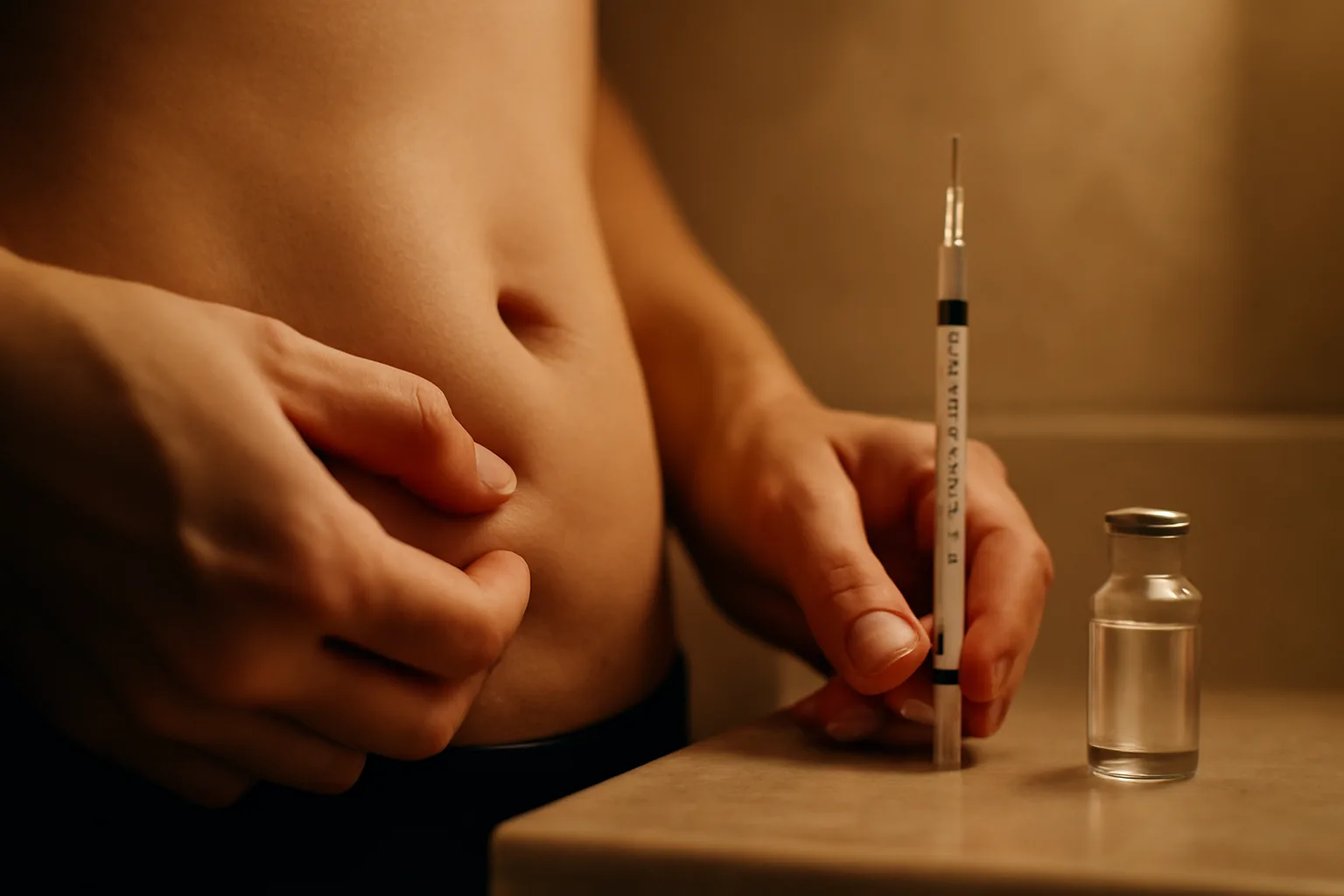
Sermorelin is given as a subcutaneous injection, meaning the needle goes into the fatty layer just under the skin, not into muscle. Most people use the abdomen (a couple of inches from the belly button) or the front of the thigh, rotating sites so you don't build up scar tissue or irritation in one spot. The typical process: reconstitute the lyophilized (freeze-dried) powder with the diluent your pharmacy provides, draw up the prescribed volume with an insulin syringe, pinch the skin, and inject at roughly a 45 to 90 degree angle. You don't need to inject into muscle, and you don't need a big needle. Insulin syringes (usually 29-31 gauge) are standard because the volumes involved are small, often well under half a milliliter. Once mixed, sermorelin is not shelf-stable at room temperature indefinitely. Refrigeration and a reasonable use-by window (your pharmacy will specify it) matter, because peptides degrade over time, and enzymatic and serum stability studies on GHRH-related peptides confirm these molecules break down under real-world handling conditions [1]. Sloppy storage is a real way to waste a vial and get inconsistent dosing.
when is the best time to take sermorelin?
Nighttime, right before bed, on an empty stomach. This isn't a preference thing, it's tied to how growth hormone secretion actually works. The pituitary releases its largest natural GH pulses during early deep sleep, and sermorelin is designed to amplify that same signal, not override the body's rhythm. Most clinical protocols for sermorelin, going back to its original approved formulation, had patients inject at bedtime for this reason. Taking it after a meal, especially one with carbohydrates, blunts the response, because elevated blood sugar and insulin suppress growth hormone release. That's why prescribers generally tell people to wait 2 to 3 hours after eating before injecting. Consistency matters more than people expect. Injecting at wildly different times night to night, or skipping doses irregularly, works against the pulsatile pattern the therapy is trying to support.
what is the typical sermorelin dosing schedule?
There is no single universal sermorelin dose, because it depends on the compounded concentration, the person's weight and goals, and the prescriber's judgment. That said, the pattern across published use is a once-daily subcutaneous injection at bedtime, typically in the range of 200 to 300 micrograms for adults, though pediatric growth hormone deficiency protocols used weight-based dosing that was studied and reviewed in detail in the late 1990s [2]. Because sermorelin isn't a single-dose-fits-all drug, and because it's compounded rather than sold as an FDA-approved product anymore, the exact number on your prescription label is the number that matters, not a generic chart. Compounding pharmacies mix concentrations differently, so 0.2 mL from one pharmacy's vial is not interchangeable with 0.2 mL from another's. A table of commonly discussed dosing patterns for adult use looks roughly like this, though again, this reflects general clinical patterns rather than an FDA-set standard, since Geref (the original branded sermorelin) is discontinued and current use is entirely through compounding:
| Use context | Typical frequency | Typical range discussed | |
|---|---|---|---|
| Adult GH support (compounded) | Once nightly | ~200-300 mcg/dose | |
| Pediatric GH deficiency (as studied historically) | Once nightly | Weight-based, per pediatric endocrinology protocol | |
| Diagnostic GH stimulation testing | Single dose | Higher single bolus, clinical setting only | Don't try to back-calculate a dose from a bodybuilding forum. Talk to whoever is prescribing it. |
how long does it take to see sermorelin's effects?
Slowly, and unevenly, which surprises a lot of people expecting a fast result. Because sermorelin works by stimulating your own pituitary rather than delivering growth hormone directly, the downstream effect on IGF-1 (the marker most prescribers track) builds over weeks, not days. A study in hypogonadal men using growth hormone secretagogue treatment found it raised serum IGF-1 levels over the treatment course, which is the standard way clinicians check whether the therapy is doing anything measurable [3]. That's a blood test, not a mirror check. If your prescriber is monitoring you properly, expect periodic IGF-1 labs rather than a subjective before-and-after judgment. Many protocols run for a period of months with lab recheck points, then reassess. If you want a fuller picture of what realistic timelines and outcomes look like, the sermorelin peptide before and after breakdown covers that in more depth.
should you take sermorelin on an empty stomach?
Yes. Food, particularly carbohydrate-heavy meals, raises blood glucose and insulin, and both suppress the pituitary's growth hormone response. Since sermorelin's entire mechanism depends on triggering a GH pulse, eating right before or after a dose works directly against the drug's purpose. The standard guidance is to inject at least 2 hours after your last meal and, ideally, right before sleep when you won't be eating again anyway. This is one of the more concrete, low-ambiguity rules in sermorelin dosing, unlike some of the vaguer lifestyle advice floating around peptide forums.
how does sermorelin compare to HGH, and is it weaker?
Sermorelin is not HGH. It's a growth-hormone-releasing hormone (GHRH) analog, a fragment that tells your pituitary gland to make and release its own growth hormone. HGH (somatropin) is the hormone itself, injected directly. That distinction changes everything about how the two behave. Because sermorelin depends on a working pituitary, it has a built-in ceiling: your gland won't release GH indefinitely no matter how much sermorelin you give it, since normal feedback loops (via somatostatin and IGF-1) still apply. HGH has no such ceiling; it bypasses the pituitary entirely and raises GH and IGF-1 directly, which is exactly why HGH is more predictable in its effect size and more prone to overshoot and side effects like fluid retention, joint pain, and insulin resistance if mismanaged. An older clinical review of sermorelin for adult-onset growth hormone insufficiency argued its self-limiting, pulsatile mechanism was a genuine advantage for safety, essentially trading some potency for a lower risk of overdosing the system [4]. That's the honest tradeoff: sermorelin is gentler and arguably safer to titrate, but it will not produce the magnitude of change that direct HGH can, and it does nothing for someone whose pituitary can't respond (for example, due to pituitary damage or certain tumors). If you're deciding between the two, the real question isn't which is "stronger," it's whether your goal calls for amplifying your own axis or replacing it outright. For background on how sermorelin's evidence base holds up on its own terms, see sermorelin.
why was Geref (branded sermorelin) discontinued, and is that a red flag?
No, it isn't a safety red flag. This is worth being precise about because misinformation spreads easily here. Sermorelin was originally FDA-approved and marketed in the US under the brand name Geref, primarily for diagnosing and treating growth hormone deficiency in children [2]. It was discontinued for business reasons, low commercial demand as synthetic HGH became more available and practical, not pulled for a safety signal or an FDA enforcement action. You can verify a drug's approval and marketing history through Drugs@FDA, the FDA's official database of approved products [5]. Geref no longer appears as an actively marketed product there, which fits a discontinuation rather than a withdrawal. Because there's no currently approved commercial sermorelin product, virtually all sermorelin used today comes from compounding pharmacies. That shifts the regulatory framework entirely: instead of FDA drug approval, sermorelin's availability rests on the compounding rules under 21 U.S.C. 353a and the FDA's bulk drug substance lists for 503A and 503B pharmacies [6] [7] [8]. This is a genuinely different, and less standardized, regulatory environment than an approved drug, and it's why sourcing quality matters so much.
is sermorelin legal, and does it require a prescription?
Yes, it requires a prescription in the US, and no, it isn't something you legally buy over the counter or import for personal use as a "research chemical." Because there's no FDA-approved sermorelin product on the market anymore, it's available exclusively through prescription compounding, meaning a licensed prescriber has to determine it's appropriate for you and a licensed 503A or 503B pharmacy has to prepare it [6] [7]. The FDA maintains a bulk drug substances list that governs what compounders can legally use for 503A compounding, and sermorelin's status on that list (and any updates to it) directly affects what pharmacies can legally produce [8]. This is a moving regulatory target, not a fixed one, so a pharmacy operating in full compliance today is following current FDA guidance, not a permanent green light. Buying sermorelin from an unlicensed overseas seller sidesteps this entire system, and that carries real risk beyond legality. A European investigation into falsified biopharmaceutical injectables found counterfeit and substandard injectable products circulating outside legitimate pharmacy channels, which is exactly the risk profile of grey-market peptide sales [9]. If you're weighing where to get it, best place to buy sermorelin and sermorelin reviews go into what a legitimate source actually looks like.
can you take sermorelin and other peptides together, like tesamorelin?
Combining GHRH analogs is a real practice in some clinical and off-label settings, but it isn't a casual stack you assemble on your own. Sermorelin and tesamorelin are both GHRH analogs; tesamorelin is actually FDA-approved for a specific, narrow indication (HIV-associated lipodystrophy), which gives it a firmer approval basis than sermorelin currently has. Stacking two drugs that act on the same receptor pathway doesn't necessarily add benefit, it can just mean redundant signaling or an increased side effect load without a clear upside. Anyone considering this needs a prescriber actively managing it, not a self-designed protocol. The can stack tesamorelin and sermorelin piece walks through what's actually known versus assumed here.
what happens if you take too much sermorelin, or take it improperly?
Overdosing sermorelin in the acute, dangerous sense is unlikely precisely because of its self-limiting mechanism. Your pituitary's own feedback loops cap how much GH gets released regardless of dose, unlike direct HGH injection where more drug means more hormone with no internal brake. That said, "unlikely to be dangerous" isn't the same as "has no downside." Common issues from improper use are more mundane: injection site redness or irritation from poor rotation technique, headache or flushing shortly after dosing, and in poorly monitored long-term use, the same theoretical concerns that apply to chronically elevated GH/IGF-1 signaling. A case report described anterior cervical osteophyte-related dysphagia in a long-term growth hormone user, a reminder that sustained elevation of the GH axis over years is not something to treat casually, even though that case involved GH itself rather than sermorelin specifically [10]. This is exactly why periodic lab monitoring, not guesswork, should guide how long anyone stays on a GH-axis therapy. For a longer treatment of risk over time, see sermorelin long-term side effects.
how do you know if sermorelin is even the right choice versus HGH?
It comes down to what's driving the low GH/IGF-1 picture in the first place, and that's a lab and clinical judgment, not a personal preference. If your pituitary is functionally intact and simply under-stimulated (age-related decline is the most commonly discussed scenario, though evidence there is thinner than marketing suggests), a GHRH analog like sermorelin makes physiological sense: it works with the gland rather than around it. If the pituitary itself is damaged, absent, or suppressed (certain tumors, prior surgery or radiation, some congenital conditions), sermorelin has nothing to stimulate, and direct HGH replacement is the only option that will actually raise GH levels. This is a case where sermorelin is genuinely the weaker, wrong choice, more than a gentler one. Research in hypogonadal men has looked specifically at growth hormone secretagogues (the drug class sermorelin belongs to) as a body composition management tool, distinct from androgen-receptor-targeted therapy, and found measurable IGF-1 increases, but body composition and strength outcomes in that population are a narrower claim than general "anti-aging" benefit [11] [3]. Don't let anyone selling you sermorelin promise outcomes closer to HGH than the mechanism supports.
where does sermorelin research stand right now, outside of GH deficiency?
Interest in GHRH analogs and related peptides has expanded into orthopedic and sports medicine research, though the evidence there is early and often mixed with unapproved analog use, not sermorelin's original diagnostic/pediatric indication. A 2026 review of therapeutic peptides in orthopedics discusses GHRH-class peptides among a broader set of investigational agents, flagging both potential applications and real challenges around evidence quality and regulation [12]. A companion 2026 review specifically on peptide therapies for musculoskeletal injuries and athletic performance covers safety and efficacy questions for both approved and unapproved peptides in this space, and treats the approved/unapproved distinction as clinically important, more than a technicality [13]. There's also a notably unusual thread of research: a 2021 paper explored sermorelin as a "potentially effective drug" for patients with recurrent glioma, a use case entirely outside growth hormone deficiency [14]. That's early, mechanistic-stage interest, not a treatment recommendation, and it illustrates how a decades-old peptide can still generate new research questions. Separately, a large body of analytical chemistry research exists purely because sermorelin and related GHRH analogs are banned in competitive sport; anti-doping labs have developed increasingly sensitive mass spectrometry and immunoaffinity methods to detect these peptides in urine, plasma, and blood at very low concentrations [15] [16] [17] [18]. None of that detection research changes how sermorelin is used clinically, but it does confirm regulators treat it as a substance with real physiological effect worth policing in sport, not an inert placebo peptide.
what's the actual step-by-step for a first sermorelin dose?
Once you have a prescription and your compounded vial from a legitimate pharmacy, the practical routine looks like this: reconstitute per the pharmacy's instructions if it arrives lyophilized, store it refrigerated, and pull it out about 10 to 15 minutes before your dose so it's not injecting ice-cold. Wash hands, wipe the injection site and the vial top with an alcohol swab, draw the prescribed volume into an insulin syringe, and check for air bubbles. Pinch a fold of skin at your chosen site (abdomen and thigh are the standard rotation), inject subcutaneously, and hold gentle pressure for a few seconds after withdrawing the needle. Dispose of the needle in a sharps container, not the regular trash. Do this nightly, at roughly the same time, on an empty stomach, and keep whatever lab monitoring schedule your prescriber sets. If you notice unusual swelling, persistent redness, or symptoms like headache or vision changes, that's a call to your prescriber, not a wait-and-see situation. Working through Sermorelin Co connects you to a provider-reviewed process rather than a guess-and-hope approach, and the fulfilling pharmacy partner in that process handles the compounding side under the regulatory framework described above, not the brand itself.
Frequently asked questions
Do you inject sermorelin every day or just a few times a week?
Most protocols call for a nightly subcutaneous injection, seven days a week, because the goal is to consistently support the body's natural sleep-related GH pulse. Skipping doses irregularly undercuts the pattern the therapy relies on. Your prescriber may adjust frequency based on labs and response, so follow your specific prescription rather than a generic schedule.
Can you take sermorelin in the morning instead of at night?
It's not recommended. Sermorelin is designed to amplify the natural GH pulse that happens during early deep sleep, so bedtime dosing on an empty stomach matches that biology. Morning dosing, especially after breakfast, works against the mechanism because food-driven insulin release suppresses GH secretion.
How is sermorelin injected, subcutaneous or intramuscular?
Subcutaneous, into the fatty tissue just under the skin, typically in the abdomen or thigh. It does not need to go into muscle. Insulin syringes with fine needles (commonly 29-31 gauge) are standard because the injection volumes are small.
How long before you see results from sermorelin?
Effects build gradually over weeks as IGF-1 levels rise, tracked through periodic blood tests rather than a quick visible change. There's no fixed universal timeline; response depends on dose, individual physiology, and pituitary function. Prescribers typically recheck labs at set intervals rather than promising a specific week-by-week result.
Is sermorelin the same as HGH?
No. Sermorelin is a growth-hormone-releasing hormone (GHRH) analog that stimulates your own pituitary to release GH. HGH (somatropin) is the hormone itself, given directly. Sermorelin has a built-in physiological ceiling from feedback loops; HGH does not, which makes HGH more potent but also more prone to overshoot.
Why is Geref, the original sermorelin brand, no longer sold?
Geref was discontinued for commercial reasons as demand shifted toward synthetic HGH, not pulled for a safety issue or FDA enforcement. You can check a drug's approval and marketing history through Drugs@FDA, the FDA's official database of approved products, to verify this kind of history.
Do you need a prescription to buy sermorelin?
Yes. There's no FDA-approved sermorelin product currently on the market, so it's available only through prescription compounding under a licensed 503A or 503B pharmacy, governed by 21 U.S.C. 353a and FDA bulk drug substance rules. Buying from unlicensed overseas sellers bypasses this system and carries real quality and legal risk.
Should sermorelin be taken with food?
No. It should be injected on an empty stomach, generally at least 2 hours after eating, because elevated blood sugar and insulin from food suppress the growth hormone pulse sermorelin is meant to trigger. Bedtime dosing naturally satisfies this since most people aren't eating right before sleep.
What's a typical sermorelin dose for adults?
Adult protocols commonly discuss roughly 200 to 300 micrograms nightly by subcutaneous injection, but the exact dose depends on the compounded concentration and your prescriber's plan. There's no FDA-set standard dose since sermorelin is only available through compounding now, so your specific prescription label is the number that matters.
Can sermorelin be combined with tesamorelin or other peptides?
Some prescribers do combine GHRH analogs, but stacking isn't automatically better since both act on the same receptor pathway and can mean redundant signaling rather than added benefit. This should only be done under active medical supervision, not as a self-designed regimen.
What are the signs sermorelin is working?
The clearest sign is a measurable rise in serum IGF-1 on follow-up labs, which is how growth hormone secretagogue treatment is typically evaluated in research. Subjective changes in sleep, energy, or body composition are harder to attribute reliably to sermorelin alone and take longer to assess than most people expect.
Is sermorelin banned in competitive sports?
Yes, GHRH analogs including sermorelin are prohibited in competitive sport, which is why anti-doping laboratories have developed increasingly sensitive mass spectrometry and immunoaffinity detection methods for it in urine, plasma, and blood. This regulatory attention reflects a real physiological effect, not an inert substance.
What happens if you miss a dose of sermorelin?
Skip it and resume your normal schedule the next night rather than doubling up. Because sermorelin depends on consistent nightly signaling to support the GH pulse pattern, occasional missed doses are unlikely to cause harm, but frequent inconsistency undermines the therapy's intended effect.
Sources
- Biomedical Chromatography, In-house standards derived from doping peptides (PMID 37688464): GHRH-related peptides show measurable enzymatic and serum degradation, underscoring the need for proper storage and handling.
- BioDrugs, Sermorelin: a review of its use in the diagnosis and treatment of children with idiopathic GH deficiency (PMID 18031173): Sermorelin was studied and used with weight-based, nightly dosing protocols in pediatric growth hormone deficiency.
- American Journal of Men's Health, Growth Hormone Secretagogue Treatment in Hypogonadal Men Raises Serum IGF-1 Levels (PMID 28830317): Growth hormone secretagogue treatment in hypogonadal men raised serum IGF-1 levels over the treatment course.
- Clinical Interventions in Aging, Sermorelin: a better approach to management of adult-onset growth hormone insufficiency? (PMID 18046908): Sermorelin's pulsatile, self-limiting mechanism is presented as a safety advantage compared to direct GH replacement for adult-onset GH insufficiency.
- FDA, Drugs@FDA approved drug products database: Drugs@FDA is the FDA's official database for verifying a drug's approval and marketing history, including discontinued products like Geref.
- Cornell Legal Information Institute, 21 U.S.C. 353a pharmacy compounding: Pharmacy compounding of drugs like sermorelin is governed by federal statute 21 U.S.C. 353a.
- eCFR, 21 CFR 216.23, the 503A Bulks List: The 503A bulk drug substances list governs what compounding pharmacies may legally use to prepare products like sermorelin.
- FDA, bulk drug substances nominated for use in compounding (current list): FDA maintains an evolving list of bulk drug substances nominated and evaluated for use in compounding, which affects sermorelin's regulatory status.
- Drug Testing and Analysis, Operation resistance: falsified antibiotics and biopharmaceutical injectables in Europe (PMID 26456392): An investigation found falsified and substandard biopharmaceutical injectable products circulating outside legitimate pharmacy supply channels in Europe.
- Frontiers in Surgery, Anterior cervical osteophyte-related dysphagia in a long-term growth hormone user (PMID 42465868): A case report documented anterior cervical osteophyte-related dysphagia in a long-term growth hormone user, illustrating risk from sustained GH axis elevation.
- Translational Andrology and Urology, Beyond the androgen receptor: growth hormone secretagogues in hypogonadal males (PMID 32257855): Growth hormone secretagogues have been studied specifically for body composition management in hypogonadal men, distinct from androgen-receptor-based therapy.
- Journal of the American Academy of Orthopaedic Surgeons Global Research & Reviews, Therapeutic Peptides in Orthopaedics (PMID 41490200): A 2026 review discusses GHRH-class peptides among therapeutic peptides being investigated in orthopedics, noting challenges around evidence quality and regulation.
- Sports Medicine, Safety and Efficacy of Approved and Unapproved Peptide Therapies for Musculoskeletal Injuries and Athletic Performance (PMID 41966639): A 2026 review treats the distinction between approved and unapproved peptide therapies for musculoskeletal and athletic use as clinically significant.
- Annals of Translational Medicine, A potentially effective drug for patients with recurrent glioma: sermorelin (PMID 33842627): A 2021 paper investigated sermorelin as a potentially effective drug for patients with recurrent glioma, outside its traditional growth hormone deficiency use.
- Drug Testing and Analysis, Advances in the detection of growth hormone releasing hormone synthetic analogs (PMID 34665524): Anti-doping science has developed advanced methods to detect synthetic GHRH analogs like sermorelin.
- Analytical Biochemistry, Cationic exchange SPE combined with UHPLC-MS/MS for detection of GHRHs in urine (PMID 37806509): Researchers developed sensitive chromatography-mass spectrometry methods to detect GHRH peptides in urine for anti-doping purposes.
- Analytical and Bioanalytical Chemistry, Qualitative identification of GHRHs in human plasma (PMID 26879649): Immunoaffinity purification combined with high-resolution mass spectrometry has been used to identify growth hormone-releasing hormones in human plasma at low concentrations.
- Journal of Pharmaceutical and Biomedical Analysis, Analysis of GHRH and its analogs in urine using nano LC-quadrupole/orbitrap MS (PMID 41138283): A 2026 method using nano liquid chromatography and quadrupole/orbitrap mass spectrometry improved detection of GHRH and its analogs in urine.