Last updated 2026-07-25
TL;DR
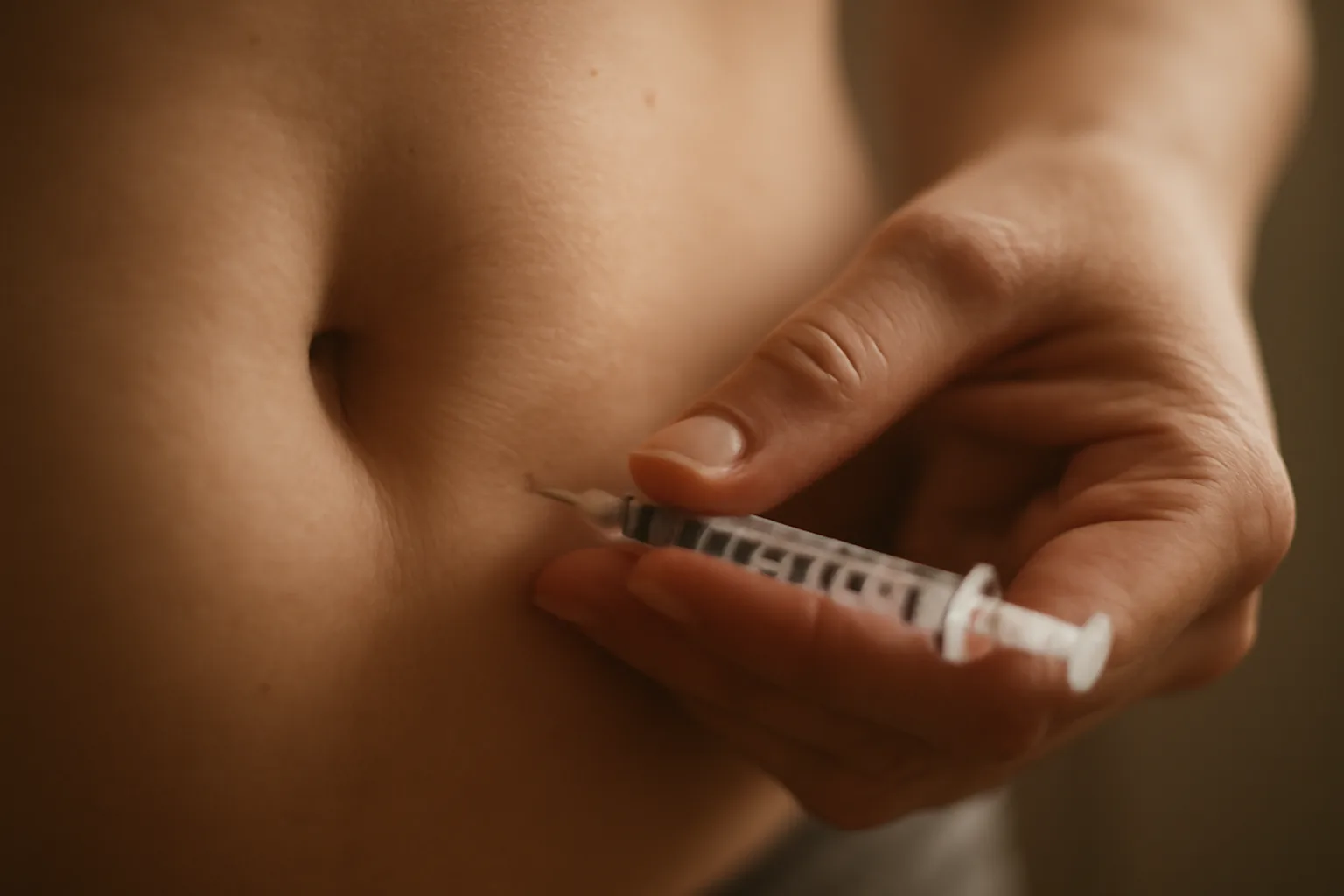
Sermorelin is given as a small subcutaneous injection, almost always in the abdominal fat around the navel, sometimes in the upper thigh. Rotate sites daily to avoid lumps under the skin. It's dosed at bedtime because it works with your natural nighttime growth hormone pulse. This is a prescription-only peptide with no FDA-approved product currently on the market; any supply comes from a compounding pharmacy.
Where do you actually inject sermorelin?
Sermorelin goes just under the skin, not into muscle. That's a subcutaneous (SubQ) injection, the same basic technique diabetics use for insulin. The go-to spot is the abdomen, roughly two inches out from the belly button, anywhere in that soft ring of fat around the navel. The second most common spot is the front or side of the thigh, the same fleshy area people use for other subcutaneous peptides and insulin. Some protocols also allow the back of the upper arm if there's enough pinchable fat there, though it's harder to reach yourself and mostly used when someone else is giving the injection. What you're looking for in any of these spots is a pinch of fat you can grab between two fingers, at least half an inch. Bone, muscle, and areas with visible veins or scar tissue are all out. If you're thin enough that you can't pinch an inch anywhere on your stomach, the thigh is usually the better option. Sermorelin was previously sold in the US under the brand name Geref, an FDA-approved product used mostly for growth hormone stimulation testing in kids. Geref was discontinued for business reasons, not pulled for a safety problem. That regulatory history is part of why sermorelin has a longer paper trail than a lot of newer peptides on the market, even though there's no branded product to buy today. If you're trying to figure out where sermorelin actually comes from today, best place to buy sermorelin covers the sourcing question directly.
How do you rotate injection sites correctly?
Rotate every day, and don't reuse the exact same quarter-inch spot two nights in a row. The standard pattern is a simple grid: think of your abdomen divided into a left side and right side, and move an inch or two over each night, working in a loop so you don't come back to the same spot for at least a week. Why bother? Repeated injections into the same tiny patch of fat cause lipohypertrophy, a lump of thickened, scarred fat tissue that also absorbs the drug less evenly. This is well documented in insulin literature and the mechanism is the same for any subcutaneous peptide. A simple rotation schedule, written down or tracked in a phone note, solves this. Some people literally use a grid drawn on paper and cross off each square as they use it. If you switch between abdomen and thigh on different nights, that also counts as rotation and gives each area more recovery time between injections. For a broader sense of how sermorelin protocols are structured around this kind of daily routine, sermorelin clinical trials is a useful reference point.
What supplies do you need and how do you prepare the injection?
You need an insulin syringe (typically 29-31 gauge, 0.5 mL or 1 mL), alcohol swabs, sharps disposal container, and the reconstituted sermorelin vial. Sermorelin comes as a freeze-dried powder that a compounding pharmacy or the patient mixes with bacteriostatic water before use. Once reconstituted, it's a fragile peptide, and cold-chain handling matters. Wipe the injection site with an alcohol swab and let it air dry for a few seconds. Alcohol trapped under the skin stings. Pinch the fat, insert the needle at roughly a 45 to 90 degree angle depending on how much tissue you have, push the plunger slowly, and hold for a few seconds before withdrawing. Don't rub the site hard afterward; a light press with gauze is enough. Keep the vial refrigerated between uses. Sermorelin and related GHRH peptides are known to degrade over time even under proper storage, and researchers studying peptide stability have specifically examined how GHRH-related compounds break down enzymatically and in serum, which is part of why cold storage and using the vial within the pharmacy's stated window matter more than they might for a more stable drug [1].
Why does timing matter as much as the injection site?
Sermorelin doesn't manufacture growth hormone itself. It stimulates the pituitary to release its own GH, and it works best when it lines up with the body's biggest natural GH pulse, which happens during the first few hours of deep sleep. That's why almost every sermorelin protocol calls for a bedtime injection, on an empty-ish stomach, rather than a morning or midday dose. This timing dependency is actually one of the clearest mechanistic differences between sermorelin and injectable HGH. HGH is the finished hormone; it works whenever you inject it, because it's not waiting on your pituitary to do anything. Sermorelin only works if the pituitary still has functioning somatotroph cells to respond to the signal. That's a meaningful limitation in older adults or anyone with significant pituitary damage, and it's discussed directly in the 2006 review on sermorelin's role in adult growth hormone insufficiency [2].
Sermorelin vs HGH: which one actually makes sense for you?
This is the question most people researching sermorelin actually care about, so here's the honest version. HGH (somatropin) is the hormone itself. It bypasses the pituitary entirely, works regardless of your own gland function, and has decades of FDA-approved use for diagnosed GH deficiency, with well-characterized dosing and monitoring. It's also a controlled, expensive, and tightly regulated product, and using it outside an approved diagnosis carries real legal and safety tradeoffs. Sermorelin is a GHRH analog, a signal, not the hormone. It only works if your pituitary can still respond, which means it's not a fit for people with significant pituitary damage or panhypopituitarism. Because it triggers your own pulsatile release rather than flooding the body with a fixed external dose, sermorelin is generally considered to carry a gentler side effect profile than direct HGH, which is one reason it's positioned as a lower-intensity option for adult-onset GH insufficiency [2]. But 'gentler' isn't the same as 'as effective.' If someone has an actual, diagnosed severe GH deficiency, sermorelin is very likely the weaker choice, precisely because it depends on a gland that may not have much left to give.
| Sermorelin | HGH (somatropin) | ||
|---|---|---|---|
| What it is | GHRH analog, signals pituitary | The hormone itself | |
| Needs working pituitary | Yes | No | |
| FDA-approved product currently sold | No (Geref discontinued) | Yes, multiple brands | |
| Typical injection | SubQ, bedtime | SubQ, varies by product | |
| Regulatory status | Prescription, compounded only | Prescription, controlled substance | If you're weighing this against other GH-axis options, it's also worth reading how sermorelin compares to oral secretagogues like MK-677, which work through a different receptor pathway entirely: mk 677 vs sermorelin. |
Is sermorelin FDA approved, and where does it legally come from now?
No branded, FDA-approved sermorelin product is currently on the market. Geref was the approved version and it was discontinued for commercial reasons, not safety findings. Today, sermorelin used clinically comes from 503A or 503B compounding pharmacies, which operate under specific federal rules rather than standard drug approval. Under 21 U.S.C. 353a, a licensed pharmacist or physician can compound a drug for an individual patient based on a valid prescription, as long as the active ingredient meets certain criteria [3]. The FDA maintains lists of bulk drug substances that can legally be used in this kind of compounding, one for 503A pharmacies under 21 CFR 216.23 and a separate one for 503B outsourcing facilities under 21 CFR 216.24 [4][5]. Whether a given substance is on those lists, and which version, actually matters for whether a specific compounded product is legitimate. This is also the core reason sourcing quality varies so much between providers. If you want the full breakdown of how to evaluate a pharmacy or clinic before you buy, see best place to buy sermorelin.
What happens if you inject into muscle instead of fat?
An accidental intramuscular injection isn't a medical emergency for a low-dose peptide like sermorelin, but it changes the absorption curve and can hurt more. Subcutaneous fat absorbs the drug more slowly and evenly; muscle tissue has more blood flow and can pull the drug in faster, plus it's simply more painful with a fine insulin needle not built for that depth. If you're using a 29-31 gauge insulin needle at the recommended angle and you're pinching an adequate fold of fat, hitting muscle is genuinely uncommon. It happens most often in very lean people injecting into the thigh without pinching enough tissue. If it happens once, don't panic. Just adjust your angle or switch to the abdomen where there's usually more cushion.
What are the real side effects at the injection site?
Most people get mild redness, a small bump, or slight stinging that resolves within an hour or two. Bruising happens occasionally, especially if you hit a small capillary, and rotating sites cuts down on this over time. Lipohypertrophy (that thickened lump from overusing one spot) is a longer-term risk if rotation is ignored, not an acute one. Beyond the injection site itself, sermorelin's broader side effect profile skews mild compared to direct HGH, which tracks with its mechanism of triggering the body's own pulsatile release rather than delivering a large fixed dose [2]. That said, sermorelin and other peptides that act on the GH-IGF-1 axis are still active endocrine drugs, and self-administration outside clinical supervision has real risks that clinicians and researchers have flagged as a growing concern in both athletic and general wellness contexts [6]. This isn't a case where 'natural' or 'gentler' means 'no monitoring needed.'
How does sermorelin dosing typically work day to day?
Dosing is individualized by a prescriber based on labs, age, and goals, so there's no single universal number, but sermorelin protocols historically use small subcutaneous doses given once daily at bedtime, echoing how Geref was dosed for GH stimulation testing and how later adult-use protocols were built around the same nightly timing [2][7]. Doses are typically adjusted based on IGF-1 lab values over the following weeks rather than symptoms alone, since IGF-1 is the standard downstream marker used to gauge whether the pituitary is actually responding. A 2017 study in hypogonadal men found that growth hormone secretagogue treatment raised serum IGF-1 levels, which is the kind of lab-based endpoint prescribers actually track rather than relying on how a patient feels week to week [8]. If your levels aren't moving, that's a conversation for your prescriber about dose or whether sermorelin is even the right tool for your situation, not something to self-adjust.
Does sermorelin actually work, and how strong is the evidence?
The strongest, longest-standing evidence for sermorelin comes from its original approved use: diagnosing growth hormone deficiency in children by testing pituitary response. A 1999 review in BioDrugs specifically evaluated sermorelin's use in diagnosing and treating idiopathic GH deficiency in children, which was its core approved indication before Geref was discontinued [9]. For adult use, the evidence base is thinner and mostly built around its role as a milder alternative for adult-onset GH insufficiency, discussed in the 2006 Clinical Interventions in Aging review [2]. There's also emerging, unrelated research interest in sermorelin outside the GH-replacement context entirely, including a 2021 paper exploring it as a potentially effective drug for patients with recurrent glioma, a completely different application from GH stimulation and not something that supports any anti-aging or performance claim [10]. If you want the fuller picture of what's actually been studied and what hasn't, sermorelin clinical trials walks through the trial landscape in more depth.
How do you get sermorelin legally, and what should you expect from a provider?
Sermorelin requires a prescription. A legitimate path starts with labs (usually IGF-1, and sometimes a stimulation test) reviewed by a licensed prescriber who confirms there's a clinical reason to consider it, then a prescription filled through a compounding pharmacy operating under the 503A or 503B rules described above [3][4][5]. Sermorelin Co's role in this process is provider-reviewed guidance, connecting people to a legitimate prescribing pathway and naming the pharmacy partner that actually fulfills the prescription, rather than compounding or manufacturing anything itself. That distinction matters in a market where counterfeit and diverted biopharmaceutical injectables are a documented problem; a 2016 analysis of falsified antibiotics and biopharmaceutical injectables in Europe is a useful reminder of why sourcing through a verifiable, licensed chain matters for any injectable peptide, more than sermorelin [11]. For a walkthrough of what to look for in a legitimate provider or pharmacy, best place to buy sermorelin covers it in detail.
What mistakes do people make with injection technique?
The most common mistake is injecting cold, straight from the fridge, which stings more and can make the injection feel worse than it needs to. Letting the syringe sit at room temperature for a minute or two first helps. The second most common mistake is not rotating sites, which shows up weeks later as small hard lumps that are annoying to inject into and absorb the drug unevenly. The third is reusing needles, which dulls the tip (more pain) and raises infection risk even though the drug itself is sterile. Last one: injecting through clothing or skipping the alcohol swab because it's late and you're tired. It's a small thing, but skin prep is one of the easiest ways to avoid a minor site infection over months of daily injections.
Frequently asked questions
Where is the best place to inject sermorelin?
The abdomen, about two inches from the belly button, in a spot with at least half an inch of pinchable fat. The upper thigh is the second most common site. Both work equally well; pick whichever gives you an easier, less painful pinch, and rotate between spots to avoid lumps.
Can you inject sermorelin into your arm?
Yes, if there's enough fat to pinch on the back of the upper arm, but it's awkward to do yourself and usually needs someone else to give the injection. Most people stick to the abdomen or thigh, which are easier to reach and pinch solo.
How often do you need to rotate sermorelin injection sites?
Rotate every single injection, ideally using a grid pattern so you don't return to the same quarter-inch spot for at least a week. Repeated use of one spot causes lipohypertrophy, a thickened lump of fat tissue that also absorbs the drug unevenly.
Is sermorelin injected into muscle or under the skin?
Under the skin, subcutaneously, not into muscle. It uses the same technique as insulin injections: a fine 29-31 gauge needle, a pinched fold of fat, and a shallow angle. Intramuscular injection isn't dangerous with this drug, but it hurts more and changes absorption speed.
Why is sermorelin usually injected at bedtime?
Because it works by prompting your pituitary to release its own growth hormone, and the body's biggest natural GH pulse happens during early deep sleep. Timing the injection before bed lines the drug up with that natural window, which is central to how sermorelin protocols are built [2].
What's the difference between sermorelin and HGH injections?
HGH is the finished hormone and works regardless of pituitary function; sermorelin is a signal molecule that only works if the pituitary can still respond. HGH has FDA-approved products on the market today; sermorelin currently does not, and is available only through compounding pharmacies.
Is sermorelin still FDA approved?
No branded sermorelin product is currently FDA-approved and sold. The original approved product, Geref, was discontinued for business reasons, not because of a safety recall. Sermorelin today is available only as a compounded product through 503A or 503B pharmacies under federal compounding rules [3][4][5].
Does sermorelin hurt more than HGH injections?
Not inherently. Both use similar fine-gauge subcutaneous needles. Pain mostly comes from technique (injecting cold, poor site rotation, reused needles) rather than which drug is in the syringe. Sermorelin's broader side effect profile is generally considered milder than HGH's, related to how it triggers natural pulsatile release [2].
Can sermorelin injection sites get infected?
It's uncommon but possible, usually from skipping alcohol swabs, reusing needles, or not rotating sites. Watch for spreading redness, warmth, or pus, which are signs to contact your prescriber rather than something to treat yourself.
How long does a sermorelin vial last once reconstituted?
It varies by pharmacy and reconstitution method, so follow the specific instructions given with your prescription. Sermorelin and related GHRH peptides are known to degrade over time even under refrigeration, which is why compounding pharmacies give a defined use window rather than an indefinite shelf life [1].
Is sermorelin a controlled substance like HGH?
No. HGH is a controlled substance under federal law with strict distribution rules. Sermorelin is prescription-only but not scheduled the same way; its main regulatory constraint is that it's only legally available as a compounded product rather than an approved commercial drug.
Can you self-inject sermorelin at home?
Yes, most patients self-inject after a brief training from their prescriber or pharmacy, the same way many people learn to self-inject insulin. It requires clean technique, proper storage, and a rotation plan, but it doesn't require a clinic visit for every dose.
Sources
- Biomedical Chromatography, 2023 (PMID 37688464): GHRH and GHRP-related peptides show measurable enzymatic and serum degradation profiles, relevant to storage and stability of reconstituted sermorelin
- Clinical Interventions in Aging, 2006 (PMID 18046908): Sermorelin's mechanism depends on pituitary responsiveness and is discussed as a potentially milder approach to adult-onset GH insufficiency compared to direct HGH
- 21 U.S.C. 353a, pharmacy compounding: Licensed pharmacists and physicians may compound drugs for individual patients under specific federal conditions
- 21 CFR 216.23, the 503A Bulks List: FDA maintains a list of bulk drug substances permitted for use in 503A pharmacy compounding
- 21 CFR 216.24, the 503B Bulks List: FDA maintains a separate bulk drug substance list for 503B outsourcing facility compounding
- Frontiers in Endocrinology, 2026 (PMID 42395176): Self-administration of performance-enhancing peptides that modulate the GH-IGF-1 axis carries risks flagged as a gap between clinical evidence and patient use
- Sports Medicine (Auckland, N.Z.), 2026 (PMID 41966639): Reviews the safety and efficacy of approved and unapproved peptide therapies including GH-axis peptides used for musculoskeletal and performance purposes
- American Journal of Men's Health, 2017 (PMID 28830317): Growth hormone secretagogue treatment in hypogonadal men raised serum IGF-1 levels, the lab marker used to monitor response
- BioDrugs, 1999 (PMID 18031173): Sermorelin's original approved use was diagnosing and treating idiopathic growth hormone deficiency in children
- Annals of Translational Medicine, 2021 (PMID 33842627): Separate research has explored sermorelin as a potentially effective drug for patients with recurrent glioma, unrelated to its GH-stimulation use
- Drug Testing and Analysis, 2016 (PMID 26456392): Documents falsified antibiotics and biopharmaceutical injectables circulating in Europe, illustrating counterfeit risk in the injectable drug supply chain