Last updated 2026-07-25
TL;DR
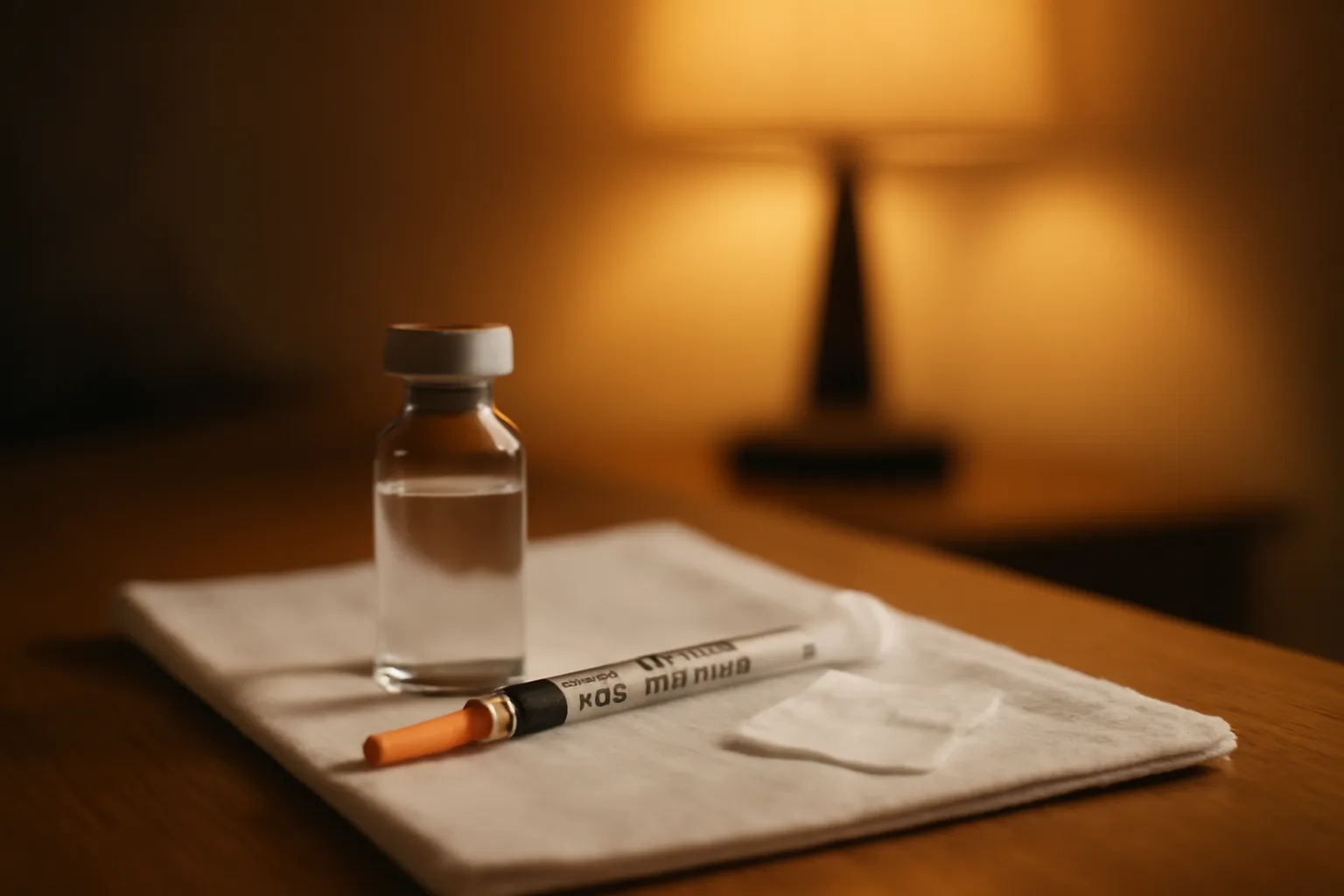
Sermorelin is injected subcutaneously, usually at night before bed, using an insulin syringe (typically 29-31 gauge) into the abdomen or upper thigh. You reconstitute the freeze-dried powder with bacteriostatic water, draw the prescribed dose, pinch the skin, and inject at a 45 to 90 degree angle. Rotate sites to avoid irritation.
What is sermorelin and how is it different from HGH?
Sermorelin is a growth-hormone-releasing hormone (GHRH) analog. It is not growth hormone itself. Instead, it's a 29-amino-acid fragment that tells your pituitary gland to make and release its own growth hormone, working through the same GHRH receptor pathway your body already uses [1]. HGH (somatropin) is the hormone itself, injected directly, bypassing your pituitary entirely. That distinction matters for how each drug behaves in the body and for how each is regulated. Sermorelin was sold in the US under the brand name Geref, approved for diagnostic testing and treatment of growth hormone deficiency. The branded product was discontinued for business reasons, not pulled for a safety problem. That's a real regulatory history most peptides sold online today don't have. A 2006 review in Clinical Interventions in Aging described sermorelin as offering a more physiologic approach to treating adult growth hormone insufficiency because it preserves the pituitary's own pulsatile release pattern and the negative feedback loop that keeps GH from overshooting [2]. A separate 1999 review covering its pediatric use reached a similar conclusion about its role in diagnosing and treating idiopathic GH deficiency in children [1]. The honest tradeoff: because sermorelin depends on a working pituitary, it can't produce the same predictable IGF-1 bump you get from injecting HGH directly. If someone's pituitary is severely damaged or largely non-functional, sermorelin has less to work with. For a full head-to-head, see sermorelin.
How do you reconstitute sermorelin before injecting it?
Sermorelin ships as a freeze-dried (lyophilized) powder in a vial. You mix it with bacteriostatic water, not regular saline or tap water, because the bacteriostatic preservative (usually 0.9% benzyl alcohol) keeps bacteria from growing in the vial across the days or weeks you'll be drawing from it. The general process: wipe the rubber stopper on both the powder vial and the bacteriostatic water vial with an alcohol swab. Draw the bacteriostatic water into a syringe, then inject it slowly down the side of the vial wall, not directly onto the powder. Slamming water straight into lyophilized peptide can shear the molecule and reduce potency. Swirl gently. Don't shake. The exact amount of bacteriostatic water your prescriber tells you to add determines your concentration, and that concentration is exactly why you should follow your prescriber's specific reconstitution instructions rather than a generic online chart. A vial mixed to a different concentration than what your dosing chart assumes will give you the wrong dose even if you draw the "correct" number of units. Once mixed, sermorelin should be stored refrigerated, and used within the timeframe your pharmacy specifies on the label. Discard cloudy or discolored solution.
What supplies do you need to inject sermorelin?
You need an insulin syringe (typically 29 to 31 gauge, 0.5 mL or 1 mL, with 100-unit markings), alcohol swabs, the reconstituted vial, and a sharps disposal container. That's it. No special training beyond what most people can learn in one demonstration from a prescriber or pharmacist.
| Supply | Typical spec | Why it matters | |
|---|---|---|---|
| Syringe | 29-31 gauge, 0.5-1 mL | Smaller gauge means less pain at injection | |
| Needle length | 4-8 mm (insulin pen) or 12.7 mm (U-100 syringe) | Subcutaneous depth only, not intramuscular | |
| Alcohol swabs | 70% isopropyl | Cleans both vial top and skin site | |
| Sharps container | FDA-cleared or rigid puncture-proof container | Safe needle disposal | Use a fresh needle every injection. Reusing needles dulls the tip, which makes the injection hurt more and slightly raises infection risk at the site. It's a small cost to skip; don't skip it. |
Where do you inject sermorelin?
Sermorelin is injected subcutaneously, meaning into the fat layer just under the skin, not into muscle. The two most common sites are the abdomen (at least two inches from the navel) and the front or outer thigh. Some people also use the back of the upper arm, though that's harder to reach alone. Rotating sites is not optional if you want this to stay comfortable. Injecting the same quarter-inch of skin every night for weeks causes lipohypertrophy (a lumpy buildup of fat under the skin) or irritation. Move at least an inch from the last injection point each night and keep a mental rotation between abdomen, left thigh, and right thigh. For a full breakdown of exact site mapping and how to rotate through a weekly pattern, see sermorelin injection sites.
What is the step-by-step process for injecting sermorelin?
1. Wash your hands. 2. Wipe the vial stopper with an alcohol swab and let it dry. 3. Draw air into the syringe equal to your prescribed dose, inject that air into the vial (this prevents a vacuum), then invert the vial and draw out your dose. 4. Tap the syringe gently to knock air bubbles to the top, and push a small amount out through the needle tip to clear air, watching for a drop of liquid at the tip. 5. Pick your site and swab it with alcohol. Let it air dry for a few seconds; injecting through wet alcohol stings more. 6. Pinch a fold of skin between two fingers. 7. Insert the needle at a 45 to 90 degree angle depending on your body fat and needle length, typically 90 degrees for a shorter insulin needle in someone with average subcutaneous fat, closer to 45 degrees for someone leaner. 8. Push the plunger slowly and steadily. 9. Withdraw the needle straight out, release the skin pinch, and press a cotton ball or gauze on the site if needed. Don't rub. 10. Drop the needle straight into your sharps container. Most people report the sensation as a brief pinch, then nothing. Some report mild redness at the site for 20 to 30 minutes.
When is the best time of day to inject sermorelin?
The standard timing is at night, roughly 30 to 60 minutes before bed, on an empty stomach. This isn't arbitrary. Your body's largest natural GH pulses happen during the early stages of deep sleep, so dosing before bed times the GHRH signal to coincide with when the pituitary is already primed to release growth hormone. Eating close to injection time can blunt the response. High blood sugar and circulating insulin both suppress GH release, so a heavy meal or sugary snack right before your dose works against what you're trying to do. Most protocols ask for at least a two to three hour gap after your last meal. Consistency matters more than the exact clock time. Whatever slot you pick, night after night at roughly the same time helps your prescriber judge whether the protocol is working when they check labs or ask about symptoms at follow-up. For a broader look at when effects typically show up on this kind of schedule, see sermorelin timeline what to expect.
How does sermorelin dosing compare to HGH dosing?
Sermorelin is dosed in micrograms and injected daily, almost always at night, to work with the body's own GH pulse. HGH is dosed in milligrams or international units and can be split across daily doses depending on the indication and prescriber protocol. The mechanism difference explains the dosing difference. HGH injections put a fixed, exogenous amount of hormone directly into circulation, so the dose maps fairly directly to blood levels. Sermorelin doses instead stimulate a response that depends on how much GH-releasing capacity the pituitary still has, so two people on the identical sermorelin dose can see different downstream IGF-1 results. A 2017 study in the American Journal of Men's Health found that GH secretagogue treatment in hypogonadal men raised serum IGF-1 levels, showing the stimulation approach does produce a measurable hormonal effect, though the size of the rise varied across the study's participants [3]. Because sermorelin works through a natural feedback loop (the pituitary and hypothalamus can down-regulate the response if GH and IGF-1 rise too high), it carries a structurally lower ceiling for overshoot than directly injected HGH. That's the main practical argument in favor of sermorelin for people who want a gentler entry point rather than the full HGH dose. It's also the reason sermorelin alone won't replace HGH for someone whose pituitary has failed.
What if you miss a dose or inject at the wrong time?
Missing a single night of sermorelin is not a medical event. Skip it and resume your normal schedule the next night; don't double up the following dose to "catch up." Doubling a dose doesn't meaningfully increase GH release since the pituitary's response is somewhat self-limiting, and it just wastes drug. If you accidentally inject earlier in the day rather than at night, don't worry about it, but try to get back to the evening schedule as soon as possible since that's when the natural GH pulse machinery is most active. An occasional off-schedule dose from a hectic day is a non-issue; a pattern of random daytime dosing just means you're less likely to see the benefit the nighttime timing is built around.
What are the most common injection mistakes people make?
The biggest one is injecting into muscle instead of subcutaneous fat, usually because the needle angle is too steep or the skin fold pinch is skipped. That doesn't make the drug dangerous, but it can make the injection hurt more and absorb differently. Other common errors: reconstituting with the wrong diluent (plain sterile water instead of bacteriostatic water, which shortens how long the vial stays usable), storing the mixed vial at room temperature instead of the fridge, injecting through wet alcohol, and not rotating sites. None of these are catastrophic on their own, but stacked together they explain most of the "this isn't working" or "this hurts every time" complaints people bring back to their prescriber. A less common but real concern: sourcing from anywhere other than a licensed pharmacy. A 2016 report in Drug Testing and Analysis documented falsified biopharmaceutical injectables circulating in Europe, a reminder that injectable peptide products bought outside verified pharmacy channels carry a real counterfeiting risk that has nothing to do with the drug's intended pharmacology [4]. Buying from a licensed, provider-reviewed source with a named fulfilling pharmacy removes that variable entirely.
Is sermorelin legal to compound, and where does it come from?
Sermorelin's regulatory status is unusual among peptides because it has an actual FDA approval history under the brand name Geref, which the manufacturer discontinued for commercial reasons rather than a safety recall [5]. That history is part of why sermorelin sits differently than many newer peptides being compounded today. Compounding pharmacies can prepare drugs from bulk substances under specific FDA frameworks: 21 U.S.C. 353a governs traditional pharmacy compounding [6], and FDA maintains lists of bulk drug substances that can be used under section 503A [7] and section 503B [8] of the FD&C Act. The regulatory eligibility of any specific peptide for compounding can change, so this is worth confirming with your prescriber and pharmacy rather than assuming last year's list still applies. What this means practically: a legitimate sermorelin prescription is filled by a licensed pharmacy operating under one of these frameworks, with a named pharmacy on the label, not shipped from an unlabeled research-chemical vendor. If a source won't name the dispensing pharmacy, that's a red flag, not a technicality.
What does the injection feel like, and what side effects show up at the injection site?
Most people describe a brief pinch on needle entry and mild pressure during the push, gone within seconds. It is generally described as less painful than a flu shot because the needle is thinner and shorter. Injection site reactions are the most commonly reported side effect category with GHRH analogs: redness, mild swelling, itching, or a small hard lump that resolves over a day or two. Rotating sites (covered above) is the single most effective way to reduce these. Reactions that spread, worsen after 48 hours, or come with fever are not typical and should go back to your prescriber. Flushing, headache, or lightheadedness shortly after injection are reported less often but are worth mentioning at follow-up if they happen more than once or twice. If you're taking other medications, check sermorelin drug interactions before starting, and if you're a woman considering this therapy, sermorelin in women covers what differs by sex.
Sermorelin versus HGH: which one should you actually consider?
This is the question most people land on this page trying to answer, so here's the direct version. Sermorelin makes sense if you have some remaining pituitary GH-releasing capacity and want a treatment that works with your body's own pulsatile rhythm rather than overriding it, and if you're comfortable with a response that builds gradually and varies somewhat between individuals. The 2006 Clinical Interventions in Aging review frames this physiologic approach as the theoretical advantage of sermorelin over direct HGH replacement for adult-onset GH insufficiency [2]. HGH makes more sense when the pituitary itself can't produce a meaningful GH response no matter how much GHRH signal it gets, which is common in significant hypopituitarism, or when a prescriber needs a more predictable, dose-controlled IGF-1 outcome for a defined medical indication. HGH is also the only option with a body of FDA-approved uses (documented in Drugs@FDA) [5]; sermorelin's own FDA-approved brand, Geref, is no longer marketed. Neither drug is a proven anti-aging or performance-enhancement product, regardless of how it's marketed online, and a 2026 review in the Journal of the American Academy of Orthopaedic Surgeons on therapeutic peptides in orthopaedics is explicit that evidence for many peptide applications, including growth-hormone-axis peptides, remains limited and that regulatory and safety questions are still being worked out [9]. A companion 2026 review in Sports Medicine on peptide therapies for musculoskeletal injuries and athletic performance reached a similarly cautious conclusion about the gap between enthusiasm and controlled evidence for these compounds [10]. If you're weighing sermorelin against another secretagogue rather than HGH, see mk 677 vs sermorelin for that specific comparison.
How do you know if the injection is actually working?
You won't feel sermorelin working the way you'd feel, say, a stimulant. The changes it's meant to produce (modest shifts in body composition, sleep quality, IGF-1 levels) happen over weeks, and the only reliable way to confirm anything is blood work your prescriber orders, typically an IGF-1 level checked a few weeks to a couple of months into treatment. Don't judge the injection technique by how you feel that night. Judge the treatment by what your prescriber's follow-up labs show over time, and judge your injection technique by whether you're getting clean, low-irritation sites with functional consistency, not by any immediate sensation.
Frequently asked questions
Do you inject sermorelin into muscle or under the skin?
Under the skin (subcutaneous), not into muscle. Pinch a fold of fat, typically on the abdomen or thigh, and insert a short insulin needle at roughly a 45 to 90 degree angle depending on your body fat level. Injecting into muscle isn't dangerous, but it tends to hurt more and isn't how the drug is intended to be delivered.
What needle size is used for sermorelin injections?
Most protocols use a 29 to 31 gauge insulin syringe, 0.5 to 1 mL, with a needle length of about 4 to 8 mm for pen-style injectors or roughly 12.7 mm for a standard U-100 insulin syringe. The thinner the gauge number, the finer the needle, which generally means less pain on injection.
Can you inject sermorelin during the day instead of at night?
You can, but it works against the point of the drug. Sermorelin is timed to bedtime because the body's largest natural GH pulses happen during early deep sleep, and dosing then lines the GHRH signal up with that window. An occasional daytime dose from a scheduling issue is not harmful; making it a habit likely blunts the intended effect.
What do you mix sermorelin with before injecting?
Bacteriostatic water, not plain sterile water or saline. The bacteriostatic preservative (typically 0.9% benzyl alcohol) keeps the mixed vial usable for the days or weeks between reconstitution and finishing the vial. Your prescriber or pharmacy will specify the exact volume to add based on your prescribed dose and vial strength.
How long does a reconstituted sermorelin vial last?
This depends on the specific formulation and your pharmacy's labeling, so follow the beyond-use date printed on your vial rather than a generic rule. Store the mixed vial refrigerated, not at room temperature, and discard it if the solution turns cloudy or discolored before that date.
Does injecting sermorelin hurt?
Most people describe it as a brief pinch, less painful than a typical vaccination, because the needle is thin and short and the injection goes into fat rather than muscle. Mild redness or a small lump at the site for a day or two is common and usually resolves faster with site rotation.
Is sermorelin the same as HGH?
No. Sermorelin is a growth-hormone-releasing hormone analog that signals your own pituitary to release growth hormone. HGH (somatropin) is the hormone itself, injected directly. Sermorelin depends on a functioning pituitary to work; HGH does not need one, which is why HGH is used when pituitary capacity is severely limited.
Was sermorelin taken off the market for safety reasons?
No. The branded product, Geref, was discontinued by its manufacturer for business reasons, not withdrawn by the FDA for a safety problem. That gives sermorelin a documented approval history that most peptides sold today don't have, even though the specific branded product is no longer marketed in the US.
What happens if you miss a dose of sermorelin?
Skip it and resume your normal schedule the next night. Don't double the following dose to make up for it; the pituitary's response to GHRH is somewhat self-limiting, so doubling up doesn't meaningfully boost the effect and just wastes the drug.
Where on the body should you rotate injection sites?
Common rotation points are the abdomen (at least two inches from the navel), the front or outer thigh, and sometimes the back of the upper arm. Move at least an inch from your last injection spot each night and cycle between two or three general areas to avoid lumps and irritation from repeated use of the same tissue.
Can you buy sermorelin without a prescription?
Legitimate sermorelin comes from a licensed pharmacy filling a prescription under FDA compounding frameworks such as 21 U.S.C. 353a, with a named pharmacy on the label. Unlabeled research-chemical sellers online carry real counterfeiting and quality risk documented in pharmaceutical injectable investigations, and don't offer the prescriber oversight this therapy is meant to have.
How is sermorelin dosing different from HGH dosing?
Sermorelin is dosed in micrograms, usually as a single nightly injection meant to stimulate the body's own GH pulse. HGH is dosed in milligrams or international units and delivers a fixed amount of hormone directly. Because sermorelin relies on remaining pituitary capacity, identical doses can produce different IGF-1 responses between individuals.
Sources
- PubMed, Sermorelin: a review of its use in the diagnosis and treatment of children with idiopathic growth hormone deficiency (BioDrugs, 1999): Sermorelin is a GHRH analog that stimulates the pituitary's own GH release rather than replacing GH directly
- PubMed, Sermorelin: a better approach to management of adult-onset growth hormone insufficiency? (Clinical Interventions in Aging, 2006): Sermorelin offers a more physiologic approach to treating adult GH insufficiency by preserving pulsatile release and feedback regulation
- PubMed, Growth Hormone Secretagogue Treatment in Hypogonadal Men Raises Serum Insulin-Like Growth Factor-1 Levels (American Journal of Men's Health, 2017): GH secretagogue treatment in hypogonadal men raised serum IGF-1 levels
- PubMed, Operation resistance: A snapshot of falsified antibiotics and biopharmaceutical injectables in Europe (Drug Testing and Analysis, 2016): Falsified biopharmaceutical injectables have been documented circulating in Europe outside legitimate pharmacy channels
- Drugs@FDA, FDA-approved drug products database: Sermorelin was previously approved and marketed in the US under the brand name Geref, later discontinued commercially
- Cornell Law School, Legal Information Institute, 21 U.S.C. 353a (pharmacy compounding): Federal law 21 U.S.C. 353a establishes the framework under which pharmacies may compound drugs
- FDA, Bulk drug substances used in compounding under section 503A: FDA maintains a list of bulk drug substances eligible for use in compounding under section 503A of the FD&C Act
- eCFR, 21 CFR 216.24 (503B Bulks List): 21 CFR 216.24 establishes the bulk drug substances list applicable to outsourcing facilities under section 503B
- PubMed, Therapeutic Peptides in Orthopaedics: Applications, Challenges, and Future Directions (JAAOS Global Research & Reviews, 2026): Evidence for many therapeutic peptide applications, including regulatory and safety questions, remains limited
- PubMed, Safety and Efficacy of Approved and Unapproved Peptide Therapies for Musculoskeletal Injuries and Athletic Performance (Sports Medicine, 2026): A gap exists between enthusiasm for peptide therapies in athletic performance and the controlled evidence supporting them