Last updated 2026-07-24
TL;DR
Typical sermorelin dosing for adults is 0.2 to 0.3 mg (200-300 mcg) injected subcutaneously once daily at bedtime, drawn from a reconstituted vial and measured in units on an insulin syringe. Doses used in published trials ranged roughly 0.03 to 1 mg/kg in children and up to about 30 mcg/kg in adult studies; clinical use today sits well below the old FDA-approved ceiling.
What is the standard sermorelin dosage for adults?
Most prescribers land in a narrow band: 0.2 mg to 0.3 mg per day, given as a single subcutaneous injection at night. Some protocols start lower, around 0.1 mg, for the first one to two weeks to check tolerance before moving up. A smaller group of prescribers push to 0.4 mg or 0.5 mg in patients who tolerate it well and aren't seeing much response at the standard dose, though data on doses that high in healthy adults is thin. This isn't a drug with a single FDA-cleared adult dose anymore. The branded version, Geref, was approved by the FDA in 1990 for diagnostic testing of growth hormone deficiency and for treatment of pediatric growth hormone deficiency, with pediatric dosing set at 0.03 mg/kg administered subcutaneously once daily at bedtime [1]. That's the only dose with real regulatory weight behind it, and it was written for children, not for adults chasing better sleep or body composition. Today's adult protocols come from compounding pharmacies and hormone clinics extrapolating from that pediatric dose and from older endocrine research, not from a new adult-specific approval. That matters. It means the "standard" adult dose you see repeated across clinic websites is a clinical convention, not a label claim.
Sermorelin dosage chart: mg, mcg, units, and mL side by side
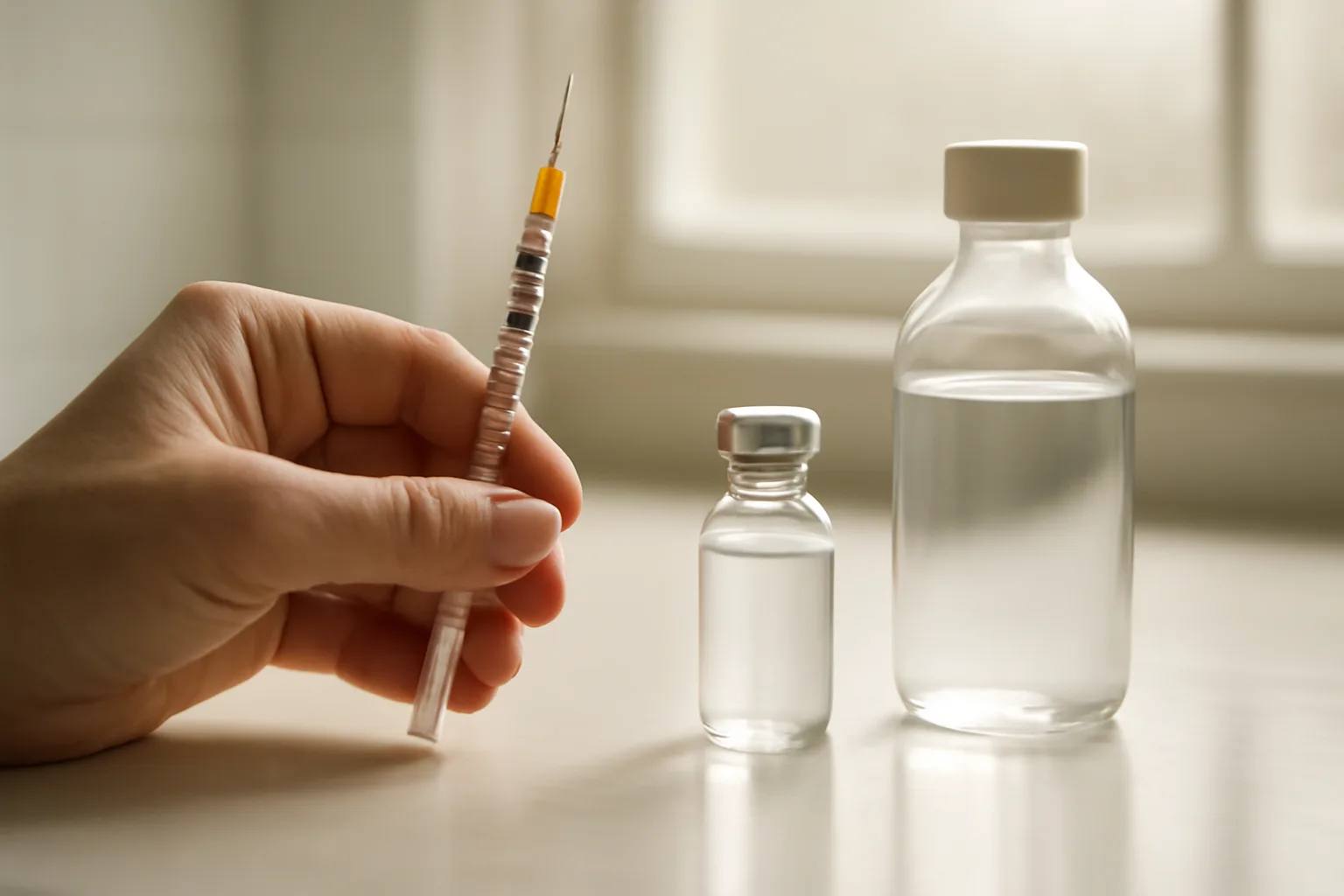
Sermorelin is sold as a lyophilized (freeze-dried) powder that gets reconstituted with bacteriostatic water, then drawn up in an insulin syringe marked in units. Confusion happens because clinics quote dose in milligrams, syringes measure in units, and reconstitution volume changes what one unit actually delivers. Here's how the common ranges line up, assuming a typical reconstitution of a 5 mg vial with 2 mL of bacteriostatic water (a common but not universal ratio; always follow your pharmacy's specific instructions).
| Dose (mg) | Dose (mcg) | mL (at 2.5 mg/mL) | Units on U-100 syringe | |
|---|---|---|---|---|
| 0.1 mg | 100 mcg | 0.04 mL | 4 units | |
| 0.2 mg | 200 mcg | 0.08 mL | 8 units | |
| 0.3 mg | 300 mcg | 0.12 mL | 12 units | |
| 0.4 mg | 400 mcg | 0.16 mL | 16 units | |
| 0.5 mg | 500 mcg | 0.20 mL | 20 units | That table only works for a 5 mg vial mixed with exactly 2 mL. Change the vial size or the diluent volume and every number shifts. A 5 mg vial mixed with 5 mL of water gives you 1 mg/mL instead of 2.5 mg/mL, so a 0.3 mg dose becomes 0.3 mL (30 units) instead of 0.12 mL. This is the single most common dosing error people make with sermorelin: using a dosage chart built for someone else's reconstitution ratio. If you want to skip the arithmetic, run your specific vial size and target dose through a sermorelin dosage calculator rather than eyeballing a generic chart. |
How much sermorelin per day should you take?
One dose a day is the norm, not multiple doses. Sermorelin has a short half-life, roughly 10 to 20 minutes in circulation based on pharmacokinetic data from sermorelin acetate injection labeling [2], so it's designed to trigger a single pulse of growth hormone release rather than to sit in the blood all day. Once you've injected, its job is essentially done within the hour. Because growth hormone release is naturally pulsatile and largest during early slow-wave sleep, sermorelin is dosed at bedtime, on an empty stomach, typically 2 to 3 hours after the last meal. Food, especially carbohydrate and fat, blunts growth hormone secretion, so timing matters more with this peptide than with many others. Daily dosing for 8 to 12 weeks is a common protocol length before reassessing, sometimes with a break afterward. There's no strong evidence that splitting the daily dose into two smaller injections improves outcomes, and doing so just means more injections for no clear benefit.
What dose was used in the actual clinical trials?
Doses studied in the medical literature vary more than the tidy 0.2-0.3 mg clinic convention suggests. The original Geref label listed a pediatric dose of 0.03 mg/kg/day (about 30 mcg/kg) for children with growth hormone deficiency [1]. Older diagnostic protocols for testing GH reserve used a single bolus, given intravenously rather than daily, which is a completely different use case from home injection [2]. Studies in older adults looking at sleep and growth hormone axis effects used weight-based dosing before sleep in some protocols, though sample sizes were small and results modest. A widely cited trial by Corpas and colleagues in older men, published in the Journal of Clinical Endocrinology & Metabolism, found that six months of sermorelin restored GH and IGF-1 levels toward those seen in younger men, without producing the large gains associated with direct HGH injection [3]. The honest takeaway: there isn't a large, modern, dose-ranging trial in healthy adults that nails down an optimal dose. Clinics have converged on 0.2-0.3 mg largely by tradition and by extrapolation from the old pediatric label, not because a big adult trial proved that number superior to 0.1 mg or 0.4 mg.
How is sermorelin dosage in mL calculated for injection?
You need three numbers: total peptide in the vial (usually 5 mg or 10 mg), the volume of bacteriostatic water added, and your target dose in mg. Divide vial strength by water volume to get concentration (mg/mL), then divide your target dose by that concentration to get injection volume in mL. Example: a 5 mg vial reconstituted with 2 mL of bacteriostatic water gives a concentration of 2.5 mg/mL. To inject 0.3 mg, divide 0.3 by 2.5, which gives 0.12 mL. On a standard U-100 insulin syringe, where 100 units equals 1 mL, that's 12 units. Most sermorelin comes with pharmacy-specific reconstitution instructions, and reputable telehealth and compounding pharmacies will print the exact draw volume for your prescribed dose on the label or an included dosing sheet. If your paperwork doesn't match your vial, call the pharmacy before you inject anything. Getting this math wrong in either direction is the most common real-world dosing mistake with this peptide, more common than any issue with the drug itself.
Sermorelin dosage for bodybuilding: what's actually used and does it work?
Some bodybuilding and physique-focused users push sermorelin doses higher than clinical hormone-deficiency protocols, sometimes 0.5 mg to 1 mg a day, occasionally split into two doses, chasing better recovery or a leaner look. There is no solid published trial data supporting a specific bodybuilding dose, and no good evidence that higher doses produce meaningfully better body composition results in people who don't have growth hormone deficiency. Growth hormone secretagogues like sermorelin work by stimulating the pituitary to release more of a person's own GH. That means results are capped by how much GH your pituitary can actually produce, unlike direct HGH injection, which delivers a fixed external dose regardless of pituitary function. In someone with a healthy, functioning pituitary, going from 0.3 mg to 1 mg of sermorelin is unlikely to double GH output, because you eventually saturate the receptor response and run into the pituitary's own ceiling. If the goal is muscle gain or fat loss with no diagnosed GH deficiency, sermorelin is a weak tool for that job. The evidence base for performance or physique benefits in healthy adults is thin to nonexistent. This is worth saying plainly, because a lot of marketing around this peptide implies otherwise.
Sermorelin versus HGH: which dose delivers more growth hormone?
This is the real question most people are actually asking, and the honest answer is that direct HGH injection reliably raises IGF-1 and growth hormone levels more than sermorelin does, especially in adults with normal or borderline pituitary function. HGH (somatropin) is the hormone itself, dosed in adult growth hormone deficiency typically starting around 0.2 mg/day to 0.4 mg/day and titrated up based on IGF-1 levels, per FDA-approved labeling for adult GH deficiency indications such as Genotropin [4]. Because it bypasses the pituitary entirely, HGH delivers a predictable, dose-dependent effect. Sermorelin instead asks the pituitary to make more of its own GH, so its ceiling is set by however much functional pituitary tissue a person has left. In someone with significant pituitary damage, sermorelin may do very little, while HGH will still work because it doesn't need the pituitary at all. The tradeoff cuts the other way too. Because sermorelin preserves the body's natural pulsatile release pattern and requires an intact feedback loop, it carries a comparatively lower risk of overshooting into supraphysiologic GH and IGF-1 levels than direct HGH dosing, at least at the doses typically used in adult protocols. Sermorelin is also dramatically cheaper per month in most clinics and, as noted above, it has a real FDA approval history (Geref) that most compounded peptides simply don't have, even though that approval was for pediatric use and was for a product that was later discontinued for commercial reasons rather than pulled for safety [1]. For someone with confirmed adult growth hormone deficiency who wants the strongest, most predictable IGF-1 response, HGH is the more effective, better-studied option, and it's the one with FDA-approved adult labeling. For someone hoping to nudge their own GH axis without full replacement dosing, sermorelin is the gentler, cheaper approach with a smaller effect size. Read the fuller comparison of outcomes people actually report in sermorelin peptide before and after and the background on how the peptide works in sermorelin.
What happened to Geref, the original FDA-approved sermorelin?
Geref (sermorelin acetate for injection) was approved by the FDA in 1990, manufactured originally by Serono, for diagnostic testing of pituitary growth hormone reserve and for treatment of growth hormone deficiency in children [1]. It was later discontinued from the US market for commercial reasons, not because of a safety signal or an FDA safety withdrawal. That distinction matters a lot when you're evaluating sourcing today. A drug discontinued for business reasons (low sales volume, manufacturing cost, being outcompeted by other GH-axis products) has a very different risk story than one pulled by FDA for adverse events. Sermorelin's approval history gives it something most research peptides lack: a real, documented human safety and efficacy record reviewed by FDA, even though that review was narrow (pediatric GH deficiency and diagnostic use) and doesn't cover today's adult wellness dosing. Because no branded, FDA-approved sermorelin product currently exists on the US market, anything available today is produced by compounding pharmacies under prescription, not sold as an approved drug with an FDA-reviewed label for adult use. Federal law governing pharmacy compounding, including the conditions under which a compounded drug can be prepared for an individual patient with a valid prescription, is set out in the Federal Food, Drug, and Cosmetic Act section on pharmacy compounding, 21 U.S.C. 353a [5]. That's a meaningfully different regulatory category, and it's why working through a provider-reviewed process and a legitimate pharmacy partner matters more with this peptide than the marketing usually lets on.
How long before you notice a difference at a given dose?
Most people report subjective changes, better sleep depth, easier mornings, in the first two to four weeks. Objective markers like IGF-1 tend to move more slowly and are usually rechecked at 6 to 8 weeks after starting a stable dose, since IGF-1 integrates GH output over roughly 24 hours and doesn't spike from a single injection. If a prescriber is titrating your dose based on labs, expect a pattern like this: start at 0.1-0.2 mg for 2 weeks, recheck tolerance and injection site reaction, move to 0.2-0.3 mg for 6-8 weeks, then draw IGF-1 and clinical response before deciding whether to hold, increase, or stop. Jumping straight to a higher dose without this step skips the main safety check the dose escalation is designed to provide. Body composition changes, if they happen at all, typically take longer to become visible, often 3 months or more, and are heavily confounded by diet and training in anyone using sermorelin alongside a fitness program. Don't expect a dosage chart alone to predict your timeline. Individual pituitary responsiveness varies a lot, especially with age, since GH secretion naturally declines over adult life.
What are the signs a sermorelin dose is too high?
The most common early sign of too-high a dose is flushing, headache, or lightheadedness shortly after injection, along with injection site redness or itching that's more pronounced than usual. Some people report vivid dreams or difficulty falling asleep, which is counterintuitive given sermorelin is dosed for sleep, but can happen at higher doses. Longer term, signs of excess GH stimulation include joint stiffness or mild swelling in the hands, and in rare cases, worsening insulin sensitivity, since growth hormone opposes insulin action. This is why prescribers watch fasting glucose or HbA1c in anyone on sermorelin for an extended period, particularly at the higher end of the dosing range. For the fuller list of what to watch for over months of use, see sermorelin long-term side effects. If any of these symptoms show up, the standard move is to drop back to the last well-tolerated dose and hold there, not to push through and hope it resolves. A prescriber should be looped in either way, and dose changes shouldn't happen based on how a forum post described someone else's experience.
Where can you get a legitimate sermorelin prescription and dosing plan?
Sermorelin requires a prescription in the United States; it isn't sold over the counter, and legitimate sourcing runs through a licensed prescriber who reviews your labs and health history before writing a dose, then a pharmacy (often a compounding pharmacy) that fills it under that prescription. Sermorelin Co's provider-reviewed process connects you with a prescriber for that evaluation and works with a licensed pharmacy partner for fulfillment; Sermorelin Co itself doesn't compound or manufacture the peptide. Buying "research-grade" sermorelin from a peptide vendor with no prescription skips the exact safety checks (IGF-1 baseline, glucose screening, dose titration) that make this drug reasonably safe in the first place. It also means no pharmacist verifying vial concentration, sterility, or reconstitution instructions, which given the mg-to-mL math shown earlier, is exactly where dosing errors happen. If you're weighing vendors or clinics, sermorelin reviews and sermorelin peptide near me cover what to check before you commit to one.
Frequently asked questions
What is a typical sermorelin dosage chart for adults?
Most adult protocols use 0.1 mg to 0.3 mg (100-300 mcg) injected subcutaneously once daily at bedtime, often starting at the low end for 1-2 weeks before moving to 0.2-0.3 mg. Some clinics go to 0.4-0.5 mg in patients who tolerate it well. There's no single FDA-approved adult dose; these ranges come from clinical convention, not a modern label.
How much sermorelin should I take per day?
One injection a day is standard, typically 0.2 mg to 0.3 mg, given at bedtime on an empty stomach roughly 2-3 hours after eating. Sermorelin's short half-life (about 10-20 minutes) means it's built for a single daily pulse, not repeated dosing throughout the day.
How is sermorelin dosage measured in mL?
Divide your target dose (mg) by your vial's concentration (mg/mL) after reconstitution. A 5 mg vial mixed with 2 mL of bacteriostatic water gives 2.5 mg/mL, so a 0.3 mg dose equals 0.12 mL. Reconstitution ratios vary by pharmacy, so always use your specific vial's instructions rather than a generic chart.
How many units of sermorelin should I inject?
On a standard U-100 insulin syringe (100 units = 1 mL), a 0.3 mg dose from a 5 mg vial mixed with 2 mL of water works out to about 12 units. The unit count changes completely if your vial size or dilution volume is different, so confirm the units with your pharmacy's printed dosing instructions.
Is sermorelin dosed differently for bodybuilding than for hormone deficiency?
Some users push sermorelin to 0.5-1 mg/day for physique goals, but there's no solid published trial data supporting a specific bodybuilding dose or showing it improves body composition in people without diagnosed GH deficiency. Higher doses don't reliably produce proportionally more GH release once the pituitary's own capacity is saturated.
What's the difference between sermorelin dosage and HGH dosage?
HGH (somatropin) is dosed as the hormone itself, often starting near 0.2-0.4 mg/day in confirmed adult GH deficiency, and it bypasses the pituitary entirely for a predictable effect. Sermorelin stimulates the pituitary to release its own GH, so its effect is capped by pituitary function and tends to be gentler and smaller in magnitude.
Was sermorelin ever FDA approved, and is it still available as a brand?
Yes. Geref (sermorelin acetate) was FDA-approved in 1990 for diagnostic GH testing and pediatric GH deficiency treatment. It was later discontinued from the US market for commercial reasons, not pulled for safety. No branded, FDA-approved sermorelin product is currently sold; today's supply comes through compounding pharmacies under prescription.
How long does it take to feel effects at a standard sermorelin dose?
Subjective changes like sleep quality often show up in 2-4 weeks. Objective markers like IGF-1 are usually rechecked at 6-8 weeks on a stable dose, since IGF-1 reflects average GH output over about 24 hours rather than spiking after one injection.
What happens if a sermorelin dose is too high?
Common signs include flushing, headache, injection site irritation, and sometimes disrupted sleep despite bedtime dosing. Longer term, excess GH stimulation can affect insulin sensitivity and cause joint stiffness. The usual response is to drop back to the last well-tolerated dose and involve the prescribing clinician, not to push through it.
Can sermorelin dosage be split into two daily injections?
It's uncommon and not well supported by evidence. Because sermorelin's job is to trigger a nighttime GH pulse tied to slow-wave sleep, a single bedtime dose matches the body's natural rhythm better, and there's no strong data showing a split-dose schedule improves outcomes over once-daily dosing.
Does sermorelin dosage need to be adjusted by body weight?
Pediatric dosing under the old Geref label was weight-based (0.03 mg/kg/day), but most adult clinical protocols today use flat doses (0.1-0.3 mg) rather than mg/kg dosing, since adult trials haven't established a validated weight-based adult dosing formula.
How do I know my sermorelin reconstitution and dose match a dosage chart I found online?
A dosage chart only applies if your vial strength and diluent volume match the one used to build it. Confirm your pharmacy's actual concentration (mg/mL) first, then recalculate, or use a tool built for your specific numbers rather than trusting a generic chart at face value.
Sources
- U.S. FDA, Geref (sermorelin acetate) NDA approval, NDA 019826: Geref (sermorelin acetate) was FDA-approved in 1990 for diagnostic GH testing and pediatric GH deficiency treatment, with pediatric dosing of 0.03 mg/kg/day, and was later discontinued for commercial rather than safety reasons
- DailyMed, Geref (sermorelin acetate) prescribing information: Sermorelin has a short circulating half-life and diagnostic protocols used single bolus dosing distinct from daily subcutaneous injection
- Corpas E, Harman SM, Pineyro MA, Roberson R, Blackman MR. "Growth hormone (GH)-releasing hormone-(1-29) twice daily reverses the decreased GH and IGF-I levels in old men." J Clin Endocrinol Metab. 1992;75(2):530-535. PMID: 1639953: A study in older men found sermorelin-class GHRH restored GH and IGF-1 levels toward youthful values, with a smaller effect than direct HGH administration
- U.S. FDA, Genotropin (somatropin) prescribing information, NDA 019640: Adult HGH replacement dosing guidance typically starts near 0.2-0.4 mg/day and is titrated based on IGF-1 levels
- 21 U.S.C. 353a, Pharmacy compounding provisions of the Federal Food, Drug, and Cosmetic Act: Compounded sermorelin products are prepared by compounding pharmacies for an individual patient under a valid prescription and are not FDA-approved drug products with reviewed adult labeling
- MedlinePlus Medical Encyclopedia, Insulin-like growth factor 1 (IGF-1) test: IGF-1 blood levels reflect average growth hormone output over roughly a 24-hour period rather than responding to a single acute GH pulse
- National Institute of Diabetes and Digestive and Kidney Diseases, growth hormone and pituitary function overview: Growth hormone release from the pituitary is naturally pulsatile and is largest during early slow-wave sleep
- Sigalos JT, Pastuszak AW. "The Safety and Efficacy of Growth Hormone Secretagogues." Sex Med Rev. 2018;6(1):45-53. PMID: 28755838: Growth hormone secretagogues like sermorelin stimulate endogenous GH release and their effect is limited by the patient's own pituitary reserve, unlike direct GH administration