Last updated 2026-07-24
TL;DR
Sermorelin reconstitution means adding bacteriostatic water to freeze-dried peptide powder to make an injectable solution. Most vials take 1-3 mL of diluent, get stored refrigerated (not frozen), and stay stable about 20-30 days once mixed. Always follow your prescriber's and pharmacy's specific instructions, since concentrations vary by vial size.
What does it mean to reconstitute sermorelin?
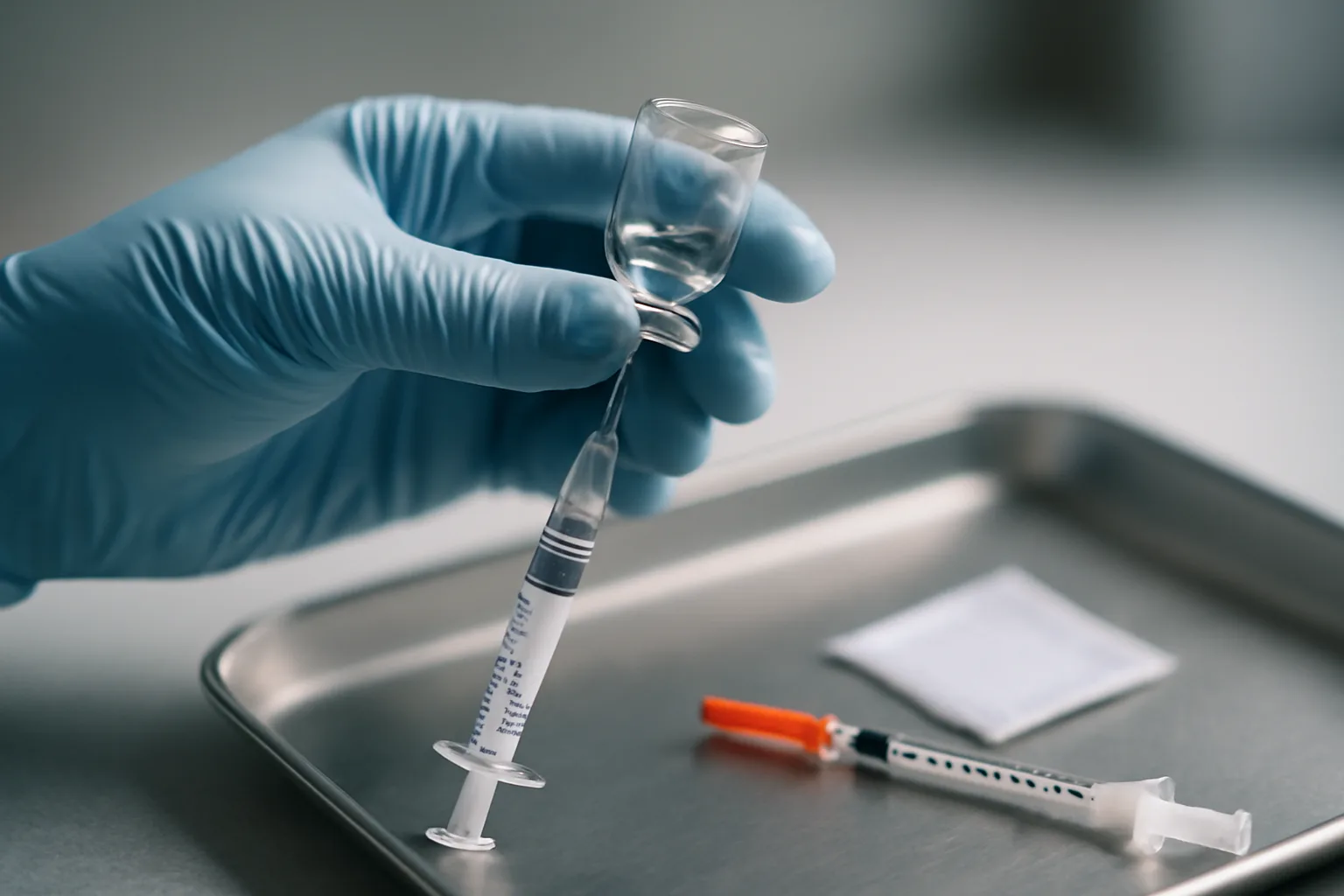
Sermorelin ships as a freeze-dried (lyophilized) powder in a sealed vial, not as a ready-to-inject liquid. Reconstitution is the step where you add a liquid, almost always bacteriostatic water, to dissolve that powder back into a solution you can draw into a syringe. Without this step there's nothing to inject. The powder alone isn't usable. This isn't unique to sermorelin. Most peptide hormones are shipped freeze-dried because the dry form is far more chemically stable during transport and storage than a liquid version would be. Growth hormone itself (somatropin) is packaged the same way for the same reason, and FDA labeling for these products reflects that shared handling logic [1]. The tradeoff is that you, or your pharmacy, have to do the mixing step correctly, because getting the volume or technique wrong changes the actual dose you're injecting. Sermorelin's history gives it a paper trail most compounded peptides don't have. It was sold in the US under the brand name Geref as an FDA-approved diagnostic and treatment product starting in the late 1980s, used both to test pituitary function and, in a different formulation, to treat growth hormone deficiency in children [2]. Geref's manufacturer discontinued the product for business reasons in the 2000s. That matters if you're trying to figure out whether sermorelin's absence from pharmacy shelves is a red flag. It isn't, in this case. It's a market decision, not a safety pull.
How do you mix sermorelin, step by step?
The reconstitution process itself is short, but the order of operations matters more than people expect. 1. Wash your hands and wipe the vial tops (both the sermorelin vial and the bacteriostatic water vial) with an alcohol swab. 2. Draw the prescribed amount of bacteriostatic water into a syringe. Most sermorelin vials (commonly 5 mg or 8 mg per vial from compounding pharmacies) are mixed with somewhere between 1 mL and 3 mL of diluent, depending on what concentration your prescriber wants and what the pharmacy's label specifies. 3. Insert the needle into the sermorelin vial at an angle, resting the needle tip against the inside glass wall rather than firing the stream straight into the powder. 4. Let the water trickle down the glass slowly. This is the step people rush, and rushing it is the single biggest cause of foaming and wasted peptide. 5. Once the water is in, gently swirl or roll the vial between your palms. Do not shake it. Shaking denatures the peptide, breaking down its structure through mechanical stress, the same reason you don't shake insulin. 6. Let the vial sit for a minute or two until the liquid is clear with no visible particles. If the solution looks cloudy, has visible clumps, or won't fully dissolve after a couple of gentle swirls, stop and contact the pharmacy that dispensed it rather than injecting it. Cloudiness can mean improper mixing, a contamination issue, or a vial that wasn't stored correctly before it reached you.
What do you mix sermorelin with, and does the diluent matter?
Bacteriostatic water is the standard diluent, and it's not interchangeable with plain sterile water for multi-dose vials. Bacteriostatic Water for Injection, USP contains 0.9% benzyl alcohol as a preservative, which is what allows a vial to be used across multiple injections over several weeks without bacterial growth taking hold [3]. Plain sterile water has no preservative, so a vial mixed with it is technically a single-use product once opened, even though nobody uses it that way in practice. Don't substitute saline, distilled water from a store, or anything else. Your pharmacy will specify bacteriostatic water on the label for a reason, and it's the same diluent used across most reconstituted peptides, not something specific to sermorelin. One caveat worth knowing: the FDA-approved labeling for bacteriostatic water carries a specific warning that formulations with benzyl alcohol have been associated with a fatal "gasping syndrome" in premature infants, and that the product should not be used in neonates [3]. This isn't relevant to adult peptide therapy dosing. But it's the reason the vial insert carries that warning, and it explains why bacteriostatic water isn't just "water with an ingredient added for no reason."
How much bacteriostatic water do you add, and how do you figure out the concentration?
The volume of diluent determines your concentration, and getting this arithmetic right is the whole game. If you add 2 mL of bacteriostatic water to a 5 mg vial, you get 2.5 mg per mL, or 2,500 mcg per mL. If you add 3 mL to that same 5 mg vial, you get roughly 1.67 mg per mL. Here's a simple reference table for common vial sizes:
| Vial size | Diluent added | Resulting concentration | Concentration in mcg/mL | |
|---|---|---|---|---|
| 5 mg | 1 mL | 5 mg/mL | 5,000 mcg/mL | |
| 5 mg | 2 mL | 2.5 mg/mL | 2,500 mcg/mL | |
| 5 mg | 3 mL | 1.67 mg/mL | 1,670 mcg/mL | |
| 8 mg | 2 mL | 4 mg/mL | 4,000 mcg/mL | |
| 8 mg | 4 mL | 2 mg/mL | 2,000 mcg/mL | Typical adult sermorelin doses run in the 200 to 300 mcg per injection range for the therapeutic use most people are pursuing, though your prescriber sets the actual number based on your labs, goals, and vial concentration. If the math above looks like a headache, it is one. It's the top reason people either underdose themselves for months or accidentally double a dose. A sermorelin dosage calculator or a sermorelin dosage chart can convert your specific vial size and diluent volume into the actual syringe units you need to draw, which is far more useful than doing it in your head at 10pm. |
How do you store sermorelin after mixing it?
Once reconstituted, sermorelin needs to live in the refrigerator, not the freezer and not the counter. Refrigeration at roughly 36 to 46°F (2 to 8°C) is the standard storage range recommended for most reconstituted peptide products, mirroring the storage guidance on FDA-approved growth hormone product labeling [1]. Most compounding pharmacies state a beyond-use date of about 20 to 30 days for reconstituted sermorelin, though this varies by pharmacy and formulation, and the exact number should be printed on your vial label. USP General Chapter 795, which governs nonsterile compounding, sets default beyond-use dating limits for water-containing formulations absent stability data, and pharmacies compounding sermorelin solutions work within that same general framework [4]. That date is not a suggestion. Peptide bonds degrade over time even under refrigeration, and using a vial well past its labeled date means you're likely injecting a partially degraded, lower-potency product. Not a dangerous one. Just a less effective one. Don't freeze the mixed vial. Freezing and thawing stresses the peptide structure and isn't how any pharmacy label instructs you to store it. Keep the vial away from direct light, and don't leave it in a car or gym bag where temperature swings are common. If you travel, a small insulated pouch with an ice pack for transit is reasonable; a mixed vial sitting in a warm bag for six hours is not.
How do you inject sermorelin peptide correctly?
Sermorelin is given as a subcutaneous injection, meaning it goes into the fatty tissue layer just under the skin, not into muscle. This is the same injection depth and technique used for insulin, which is why sermorelin uses the same short, thin insulin-style syringes (commonly 29 to 31 gauge). Basic technique: pinch a fold of skin at your chosen injection site, insert the needle at roughly a 45 to 90 degree angle depending on how much subcutaneous fat you have, push the plunger steadily, then withdraw and release the pinch. Most people report it feels like a quick pinch, not a sharp pain, if the needle is sharp and the injection is slow rather than rushed. Most prescribers recommend sermorelin injections at night, close to bedtime, because it's designed to work with your body's natural nighttime growth hormone pulse rather than override it. Injecting during the day doesn't make it dangerous, but it works against the biology the drug is designed to use, since growth hormone release from the pituitary is naturally pulsatile and peaks during early deep sleep, a pattern described in NIH-supported endocrine physiology research on GHRH and somatotropic function [5].
Where is the best sermorelin peptide injection site?
The two most common sermorelin peptide injection sites are the abdomen (avoiding a 2-inch radius around the navel) and the outer thigh. Both have enough subcutaneous fat for a clean subcutaneous injection and are easy to reach yourself. Rotate the exact spot every time you inject, even within the same general area (abdomen one night, then a different quadrant of the abdomen or the thigh the next). Injecting the exact same quarter-inch of tissue repeatedly can cause lipohypertrophy, a lump of thickened fat tissue under the skin, the same issue seen in insulin users who don't rotate sites. It's not dangerous, but it's uncomfortable and avoidable. Avoid injecting into scar tissue, moles, stretch marks, or any area that's bruised, red, or swollen from a previous injection. If a site is sore for more than a day or two, or if you notice a hard lump that doesn't resolve within a week, that's worth mentioning to your prescriber at your next check-in rather than waiting for your annual visit.
What if the sermorelin doesn't fully dissolve or looks cloudy?
A properly reconstituted sermorelin vial should be clear and colorless, with no floating particles, no cloudiness, and no visible clumps after a gentle swirl. If yours doesn't look like that, don't inject it. Common causes of a bad mix include shaking instead of swirling (which can cause the peptide to clump or foam), adding the water too fast and too directly onto the powder, or a vial that sat in poor storage conditions before you got it (heat exposure during shipping is the usual culprit). None of these make the solution acutely dangerous to inject in the sense of causing an emergency, but an improperly mixed vial likely delivers an inconsistent or reduced dose, and cloudiness can occasionally signal contamination. If a vial won't clear up after a minute or two of gentle swirling, call the pharmacy that dispensed it. Reputable compounding pharmacies replace bad vials. This is a known, non-rare occurrence and nothing to feel embarrassed about reporting.
How does sermorelin reconstitution compare to mixing HGH?
This is where the sermorelin-versus-HGH conversation gets concrete, because the two drugs are prepared almost identically but are not the same thing pharmacologically. Both ship freeze-dried and get reconstituted with bacteriostatic water using the same slow-pour, no-shake technique. Both are dosed subcutaneously with insulin-style syringes. Both require refrigeration once mixed. Mechanically, if you know how to reconstitute one, you basically know how to reconstitute the other. The difference is what's in the vial and what it does once injected. Sermorelin is a growth-hormone-releasing hormone (GHRH) analog, a 29-amino-acid peptide that signals your own pituitary gland to produce and release growth hormone [6]. Somatropin (HGH) is the growth hormone itself, identical in sequence to the body's own GH, made recombinantly and injected directly, bypassing the pituitary entirely [1]. Sermorelin only works if your pituitary is still capable of responding; it stimulates a natural, pulsatile release rather than delivering a fixed external dose. HGH works regardless of pituitary function because it's already the finished hormone. That mechanism difference has practical consequences. HGH is FDA-approved for a defined set of conditions, including adult growth hormone deficiency and specific pediatric growth disorders, and its effects on GH levels are direct and predictable [1]. Sermorelin's effect is more modest and more dependent on your own physiology; someone with significant pituitary damage or advanced age may not respond as strongly, because the gland itself has to do the work. If you're chasing a specific, guaranteed GH number, sermorelin is the weaker, less direct tool. Where sermorelin has an edge is that it preserves the body's own feedback loops (the pituitary still responds to signals telling it to slow down), which is thought to lower the risk of the kind of GH overshoot side effects, like joint swelling or insulin resistance, that are more commonly reported with direct HGH use. Read our full sermorelin overview for the mechanism in more depth.
How long does it take for reconstituted sermorelin to start working?
Reconstitution doesn't change onset time; that's determined by the drug itself, not the mixing. Sermorelin's job is to trigger a GH pulse from the pituitary within roughly 15 to 30 minutes of an injection at the cellular level, but the outcomes people actually care about (changes in body composition, sleep quality, energy) take much longer to show up, generally described in the range of 8 to 12 weeks of consistent nightly use before people report noticeable changes. There's no dose-escalation trick to speed this up, and mixing the vial "stronger" (less diluent, same amount of powder) doesn't make it kick in faster. It just changes how many mcg are in each syringe unit you draw. If you're not seeing anything after a full three-month course at the dose your prescriber set, that's a conversation for your prescriber, not a reason to freelance the concentration yourself.
Where should you actually get sermorelin, and does it matter for reconstitution quality?
Reconstitution only works as well as the vial you started with. Sermorelin bought without a prescription from an unregulated online seller carries real risk here: no guarantee of sterile manufacturing, no guarantee the powder is actually sermorelin at the labeled dose, and no pharmacist checking that your reconstitution instructions match the actual vial concentration. A prescriber evaluates whether sermorelin fits your labs and goals, then a licensed pharmacy compounds and dispenses the vial with a label specifying the exact diluent volume and beyond-use date for that batch. Sermorelin Co works through this provider-reviewed model, with prescriptions filled by Tailor Made Compounding, a licensed US pharmacy, rather than shipping unregulated raw powder. That distinction, prescription-directed compounding versus unregulated peptide sellers, is the biggest single factor in whether your reconstituted vial is actually safe to inject. For more on vetting sources, see sermorelin reviews and sermorelin peptide near me for finding a legitimate prescriber near you.
What are the safety and side effect basics to know before you start injecting?
Reconstitution technique aside, sermorelin carries the general side effect profile common to GHRH-analog injections: injection site redness or itching, flushing, headache, and occasional dizziness, most of which are mild and short-lived. Reports of these effects appear in the original Geref-era FDA approval record [2]. The more relevant long-term question, particularly since sermorelin therapy is often continued for months, is what happens with sustained use. That's a big enough topic that it deserves its own treatment; see sermorelin long-term side effects for what's actually documented. In the immediate reconstitution-and-injection context, the main practical risks are injection site irritation from poor rotation and infection risk from reusing needles or skipping the alcohol swab step, not something specific to the mixing process itself when it's done correctly.
Frequently asked questions
How do you reconstitute sermorelin at home?
Wipe both vial tops with alcohol, draw the exact volume of bacteriostatic water your pharmacy label specifies, and let it trickle slowly down the inside wall of the sermorelin vial rather than hitting the powder directly. Swirl gently until clear; never shake. Refrigerate immediately after mixing and follow the beyond-use date on your label.
What is the correct sermorelin mixing ratio?
There's no single universal ratio; it depends on your vial size and prescribed dose. A common setup is 2 mL of bacteriostatic water into a 5 mg vial, giving 2,500 mcg/mL, but pharmacies vary this based on the dose your prescriber wants per injection. Always follow your specific vial label rather than a generic online ratio.
Can you use regular water instead of bacteriostatic water for sermorelin?
No. Bacteriostatic water contains 0.9% benzyl alcohol as a preservative, which lets a multi-dose vial stay safe to use for weeks [3]. Plain sterile or distilled water has no preservative, so a vial mixed with it should be treated as single-use and discarded, which isn't how sermorelin vials are typically dosed.
How long does reconstituted sermorelin last in the fridge?
Most compounding pharmacies list a beyond-use date around 20 to 30 days for reconstituted sermorelin stored refrigerated at 36 to 46°F. The exact number is on your vial label and can vary by pharmacy and formulation, so treat the label as the final word, not a generic online estimate.
Do you need to refrigerate sermorelin before mixing it?
Unopened, freeze-dried sermorelin powder is generally more stable than the mixed solution and many pharmacies ship it with instructions to refrigerate on arrival even before reconstitution. Once mixed with bacteriostatic water, refrigeration becomes mandatory, not optional, to preserve potency through the beyond-use date.
What injection site is best for sermorelin peptide injections?
The abdomen (avoiding a 2-inch circle around the navel) and the outer thigh are the two most common subcutaneous injection sites for sermorelin. Rotate the exact spot each time to avoid lipohypertrophy, a lump of thickened fat tissue that develops from repeated injections in the same tiny area.
Is sermorelin the same as HGH?
No. Sermorelin is a GHRH analog that signals your own pituitary gland to release growth hormone; HGH (somatropin) is the growth hormone itself, injected directly [1][6]. Sermorelin only works if your pituitary can still respond, making it a gentler but less direct and less guaranteed approach than HGH.
Why was Geref (brand-name sermorelin) discontinued?
Geref was discontinued by its manufacturer for commercial reasons, not pulled by the FDA for safety or efficacy problems. Its approval history is documented in FDA's original application record for sermorelin acetate [2], and its withdrawal from the market followed a business decision rather than a safety action, which is why sermorelin is now only available compounded.
What does it mean if reconstituted sermorelin looks cloudy?
A properly mixed vial should be clear and colorless. Cloudiness usually means it was shaken instead of swirled, mixed too fast, or exposed to poor storage conditions before or after mixing. Don't inject a cloudy vial; contact the dispensing pharmacy for a replacement rather than assuming it's still fine to use.
How much bacteriostatic water do I add to a 5mg sermorelin vial?
There's no fixed universal amount; it depends on the concentration your prescriber wants. Common options are 1 mL (5,000 mcg/mL), 2 mL (2,500 mcg/mL), or 3 mL (about 1,670 mcg/mL). Your pharmacy label states the exact volume for your specific prescription; use that number, not a generic figure.
Can you inject sermorelin during the day instead of at night?
You can, but most prescribers recommend nighttime injection because sermorelin is designed to work with the body's natural nighttime growth hormone pulse during early deep sleep. Daytime injection isn't unsafe, it just works against the biology the drug relies on, so nightly, pre-bedtime dosing is the standard recommendation.
How many times can you use one reconstituted sermorelin vial?
A vial mixed with bacteriostatic water is a multi-dose vial and can be used for repeated injections until it reaches its labeled beyond-use date, typically 20 to 30 days when refrigerated. Draw each dose with a fresh needle and swab the top before each use to keep it sterile through the full period.
Sources
- FDA prescribing information for somatropin (Genotropin), storage and administration section, NDA 020280: HGH ships freeze-dried, requires refrigerated storage, and is FDA-approved for defined deficiency conditions
- FDA Drugs@FDA record for Geref (sermorelin acetate), NDA 019810 approval history: Sermorelin was FDA-approved and marketed as Geref, with documented side effects like injection site reactions and flushing, and later discontinued for commercial reasons
- FDA-approved prescribing information for Bacteriostatic Water for Injection, USP, DailyMed record: Bacteriostatic water contains 0.9% benzyl alcohol as a preservative and carries a specific neonatal toxicity warning
- United States Pharmacopeia, General Chapter <795> Pharmaceutical Compounding: Nonsterile Preparations: Compounding standards set default beyond-use dating limits for water-containing formulations absent specific stability data
- Van Cauter E, Plat L, Copinschi G. "Interrelations between sleep and the somatotropic axis." Sleep, 1998, PMID 9548287: Growth hormone release from the pituitary is naturally pulsatile and peaks during early deep sleep
- Nguyen KL, Rathi A, et al. "Sermorelin," StatPearls, National Library of Medicine, NBK556021: Sermorelin is a 29-amino-acid GHRH analog that stimulates the pituitary to release endogenous growth hormone
- FDA, "Compounding and the FDA: Questions and Answers," guidance on compounded drug products: Compounded peptide products like sermorelin are prepared and dispensed under a different regulatory framework than FDA-approved drugs, which affects sourcing and quality assurance
- MedlinePlus, National Library of Medicine, "Giving an Injection: Subcutaneous" patient instruction page: Subcutaneous injection technique, including site rotation and angle, follows standard practice shared across insulin and peptide self-injections