Last updated 2026-07-24
TL;DR
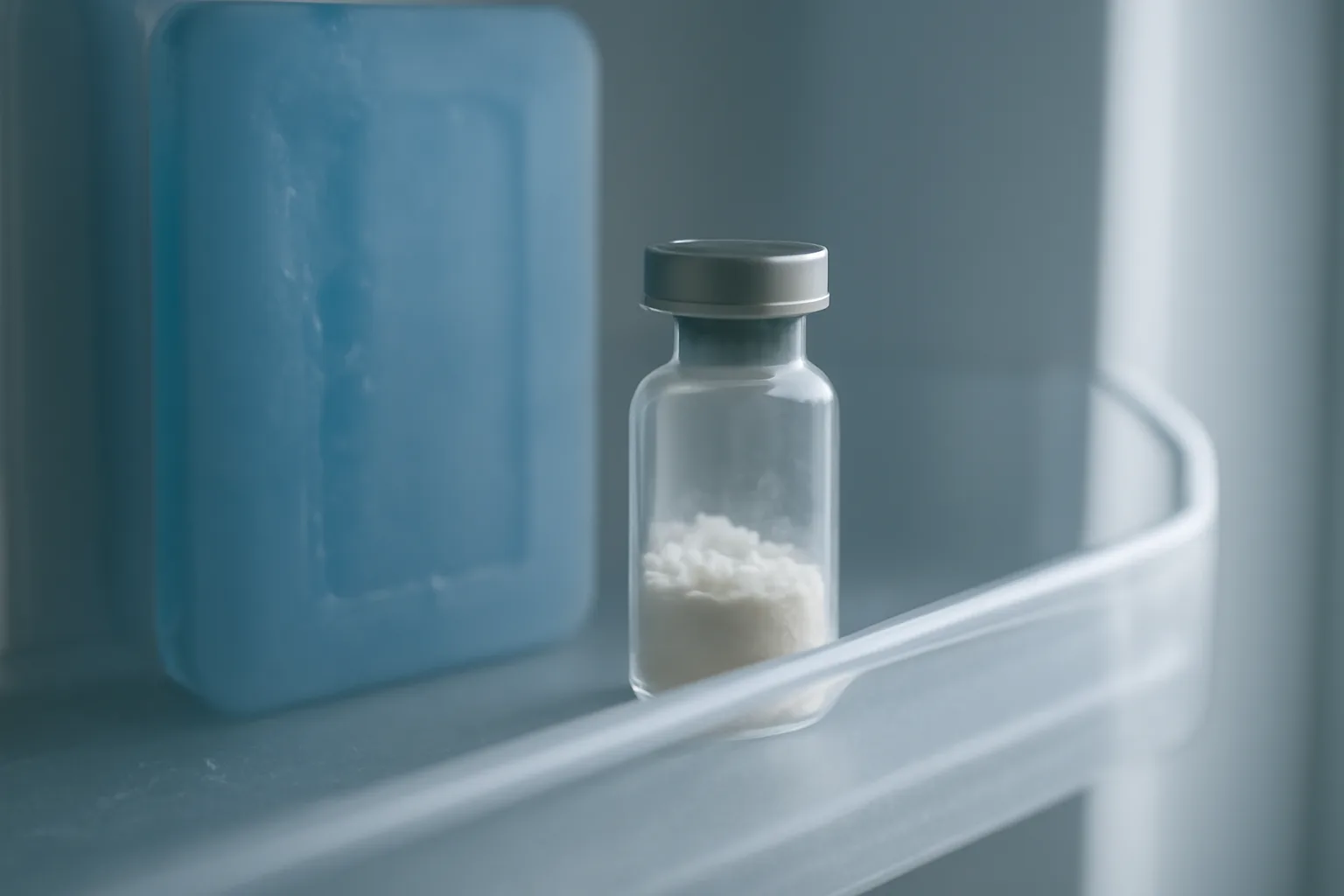
Unopened, lyophilized sermorelin should stay refrigerated (or frozen per your pharmacy's label) until its printed expiration date. Once reconstituted with bacteriostatic water, most compounding pharmacies say to keep it refrigerated (not frozen) and use it within roughly 20 to 30 days. Heat, light, and freeze-thaw cycles all degrade the peptide faster, and there's no FDA-approved sermorelin product left on the market to set a universal standard.
How should sermorelin be stored before it's mixed?
Sermorelin ships and sits as a freeze-dried (lyophilized) powder in a small glass vial. Before you reconstitute it with bacteriostatic water, it's a stable white or off-white cake, and it should go straight into the refrigerator (roughly 36 to 46°F, 2 to 8°C) unless your pharmacy's label says otherwise. Some compounding pharmacies ship with instructions to freeze unopened vials for longer-term storage and only refrigerate once you're getting close to using them. Follow the label on your specific vial over any general rule, because compounding pharmacies vary in their formulation and stability testing. The reason lyophilized peptide is so much more stable than liquid is simple chemistry: water is what drives hydrolysis and degradation. Take the water out and the peptide backbone sits in stasis for months. Add water back and the clock starts running much faster. This is true across the GHRH-analog family, more than sermorelin, and it's part of why researchers studying these peptides for detection and doping-control purposes have specifically looked at how GHRP and GHRH-related peptides degrade once they're in solution, tracking enzymatic and serum stability profiles to understand how fast they break down [1]. Don't store unopened vials in a bathroom cabinet or on a kitchen counter. Bathrooms run humid and warm, kitchens have temperature swings near the stove, and both are worse than a stable refrigerator shelf. Keep the vial in its original box, away from light, in a part of the fridge that doesn't get opened every ten minutes (the door shelf is actually one of the worst spots because of temperature swings).
How long does reconstituted (mixed) sermorelin last?
Once you add bacteriostatic water, most compounding pharmacies instruct patients to refrigerate the vial and use it within about 20 to 30 days. That window isn't an FDA-set number, since there's no FDA-approved sermorelin product on the market anymore, it's a beyond-use date set by the individual compounding pharmacy based on USP compounding standards and their own stability data. Some pharmacies are more conservative and say 2 to 3 weeks, others extend to 30 days. Always go with what's printed on your vial's label, not a number you saw on a forum. Bacteriostatic water contains 0.9% benzyl alcohol, which is what lets a multi-dose vial stay usable for weeks instead of needing to be discarded after one draw. Without a preservative, reconstituted peptide would need to be used within a day or so. That preservative doesn't stop chemical degradation, though. It stops microbial growth. The peptide itself still slowly breaks down in solution, which is why the 20 to 30 day window exists at all. If your vial looks cloudy, has visible particles, or changed color after mixing, don't use it, regardless of how many days are left in the window. That's a sign of degradation or contamination, more than normal aging.
Does sermorelin need to be refrigerated or can it be frozen?
Refrigerated, not frozen, is the standard answer for reconstituted sermorelin. Freezing a mixed vial risks damaging the peptide structure through ice crystal formation and can cause the solution to lose potency unevenly, and it also stresses the rubber stopper seal with repeated freeze-thaw cycles. For unmixed lyophilized powder, some pharmacies do recommend freezer storage for long-term stock, precisely because there's no water present to form damaging ice crystals in the peptide itself. The rule of thumb: once bacteriostatic water is added, the vial's home is the refrigerator until it's gone. Don't freeze it for later use and don't leave it out at room temperature between doses. If you travel, a small insulated cooler bag with an ice pack keeps it in range for a day or two; don't just toss it in a suitcase.
What temperature range keeps sermorelin stable?
| Lyophilized powder, refrigerated or frozen, unopened | Stable until printed expiration date | |
|---|---|---|
| Reconstituted, refrigerated (36 to 46°F) | Used within pharmacy's stated window, often 20 to 30 days | |
| Reconstituted, left at room temperature (68 to 77°F) for hours | Accelerated degradation, reduced potency | |
| Reconstituted, exposed to heat (car, direct sun) | Rapid breakdown, discard | |
| Reconstituted, frozen after mixing | Risk of physical/structural damage, not recommended | This is a general pattern for GHRH-class peptides, not a lab-verified sermorelin degradation curve. Nobody has published a definitive public stability study mapping exact potency loss per day at each temperature for reconstituted sermorelin specifically. Go by your pharmacy's beyond-use date, which is their best estimate based on compounding standards, not a guess. |
Standard refrigeration, 36 to 46°F (2 to 8°C), is the range printed on most compounding pharmacy labels for reconstituted sermorelin. Below that range you risk freezing (bad for mixed solution), and above it, especially into the 70s and 80s°F, you accelerate the peptide's natural degradation rate. Heat is the single biggest threat to a mixed vial sitting on a counter or in a hot car. Here's a rough comparison of what happens to peptide stability across storage conditions, drawn from the general behavior of lyophilized versus reconstituted GHRH-family peptides described in stability and degradation research [1]: | Storage condition | Typical outcome |
How can you tell if sermorelin has gone bad?
Visual clues come first: cloudiness, discoloration (yellowing is a common sign of oxidation), visible particles or clumps that don't fully dissolve, or a change in the way the liquid looks compared to when you first mixed it. Any of these means discard the vial, no exceptions. A less obvious sign is reduced effect. If you've been on a stable dose for weeks and suddenly notice nothing happening, and you're past the point where the vial should still be potent, degradation is a reasonable explanation before you assume the drug itself doesn't work for you. This isn't something you can test at home. There's no over-the-counter potency strip for peptides. Analytical labs use methods like UHPLC-MS/MS and immunoaffinity purification with LC-HRMS/MS to detect and quantify GHRH-analog peptides and their breakdown products with real precision [2] [3], but that's laboratory infrastructure, not something available to a patient checking a vial at home. When in doubt, throw it out. A vial that's questionable costs you nothing to replace compared to injecting something that's degraded or, worse, contaminated.
Does sermorelin expire, and where does that expiration date come from?
Yes. Every vial has an expiration or beyond-use date, and it matters more for sermorelin than for many other drugs because there's no FDA-approved commercial sermorelin product setting the standard anymore. Sermorelin was previously sold in the US under the brand name Geref, an FDA-approved product. It was discontinued by the manufacturer for business reasons, not pulled for a safety problem. That's an important distinction: 'discontinued' means the company stopped making it, not that regulators found it unsafe. Because there's no currently FDA-approved sermorelin product, what's available today comes from compounding pharmacies operating under section 503A or 503B of the Food, Drug, and Cosmetic Act [4] [5]. These pharmacies can legally compound sermorelin because it appears on FDA's evaluated bulk drug substances list for use in compounding [6] [7]. Expiration and beyond-use dates for compounded sermorelin are set by each pharmacy's own stability testing and USP compounding guidelines, not by a centralized FDA-reviewed shelf-life study the way an approved drug would have. That's why you'll see some variation in stated shelf life from one pharmacy to another; it reflects real differences in formulation and testing, not sloppiness necessarily, but it does mean the number on your label is only as good as the pharmacy behind it. This is one more reason sourcing from a provider-reviewed pharmacy relationship matters more with a compounded peptide than it would with an off-the-shelf approved drug.
Can you travel with sermorelin, and how do you keep it cold?
Short trips are manageable with planning. Use an insulated travel case with a gel ice pack, keep the vial upright, and avoid direct contact between the vial and the ice pack (frozen-solid contact can chill it too far). For flights, sermorelin and its diluent, needles, and alcohol swabs generally travel fine in a carry-on as medically necessary supplies, but check current TSA guidance and carry your prescription documentation, since compounded peptides can draw more scrutiny at security than a pharmacy-labeled prescription bottle from a major chain. Don't check it as luggage. Cargo holds aren't temperature-controlled to refrigerator range and can also freeze at altitude. If you're traveling more than a day or two, ask your prescribing provider whether it's better to pause dosing and resume on return, or whether a portable pharmaceutical cooler (the kind diabetics use for insulin) makes sense for your trip length.
Sermorelin versus HGH: does storage differ, and does it change which one is the better choice?
Storage requirements are broadly similar, both are typically shipped lyophilized and both need refrigeration once mixed, but the deeper comparison people actually want is whether sermorelin is a reasonable substitute for HGH itself. The honest answer: it depends on what you're using it for, and sermorelin is not simply 'a milder HGH.' Sermorelin is a growth-hormone-releasing hormone (GHRH) analog. It doesn't add HGH to your body directly, it stimulates your own pituitary gland to release its own growth hormone [8]. That matters because it means sermorelin can only work if your pituitary is still capable of responding, and its effect is bounded by your own physiology's feedback loops, which is part of why some clinicians have argued it may carry a different safety profile than direct HGH replacement in adult growth hormone insufficiency [8]. HGH itself is a direct, exogenous replacement of the hormone, bypassing the pituitary step entirely, which produces a stronger and more direct rise in IGF-1 but also removes your body's built-in braking system. That physiological difference has real consequences. Long-term direct HGH use has been linked to case reports of unusual complications, including a documented case of anterior cervical osteophyte-related dysphagia in a long-term growth hormone user [9], the kind of finding you don't typically see reported with GHRH-analog therapy. On the other hand, sermorelin's ceiling on effect means it's genuinely the weaker option if someone needs a large, fast, or guaranteed rise in growth hormone, for instance in certain diagnostic testing contexts or severe deficiency states where the pituitary itself isn't functioning well. In one study of hypogonadal men, GH secretagogue treatment (a related but distinct drug class from sermorelin) did raise serum IGF-1 levels, showing the mechanism can move the needle, but the magnitude and reliability differ from direct HGH dosing [10]. For most adults exploring growth hormone axis support for reasons other than diagnosed pituitary failure, sermorelin's self-limiting mechanism is arguably a feature, more than a limitation. It's harder to overshoot. But if you have documented severe GH deficiency and your pituitary itself is the problem, sermorelin may simply not be strong enough, and that's a conversation for an endocrinologist, not a peptide vendor. For a side-by-side breakdown of dosing and mechanism differences, see our sermorelin overview page.
What about sermorelin compared to other GH-axis peptides for stacking or alternatives?
People researching sermorelin storage often end up asking whether it's worth combining with or switching to other peptides in the same family, like tesamorelin or MK-677. Sermorelin and tesamorelin are both GHRH analogs, but tesamorelin has actual FDA approval for a specific indication (HIV-associated lipodystrophy) and a longer track record in that narrow use, while sermorelin exists only as a compounded product today. MK-677 is a completely different mechanism (an oral ghrelin mimetic, not an injectable GHRH analog), and it's not FDA-approved for any indication in the US. If you're weighing stacking GHRH analogs, see can stack tesamorelin and sermorelin for the mechanism-level detail. If you're deciding between an oral secretagogue and an injectable GHRH analog, mk 677 vs sermorelin covers that head to head. And if injection frequency itself is your sticking point, sermorelin peptide injection vs oral walks through why there isn't currently a credible oral sermorelin alternative on the market.
Why is sermorelin only available compounded, and does that affect quality control?
Geref, the FDA-approved branded sermorelin product, was discontinued by its manufacturer. It wasn't pulled for a safety signal; the company simply stopped producing it, which happens routinely with older drugs that lose commercial appeal. Once no manufacturer holds an active approved product, patients can only access the drug through compounding pharmacies operating under 21 U.S.C. § 353a [4], which permits compounding based on a valid prescription when certain conditions are met. Sermorelin is on FDA's list of bulk drug substances that can be used under section 503A compounding [6], and pharmacies can also compound it under 503B rules with different oversight requirements [5] [7]. This is meaningfully different from the gray-market research-chemical peptide world. A licensed 503A or 503B pharmacy has real regulatory obligations around sterility, potency testing, and labeling that an unregulated online seller doesn't. That distinction matters enormously for a peptide with no remaining FDA-approved commercial version, because the compounding pharmacy's internal quality standards are effectively the only quality floor left in the system. This is exactly why sourcing through a provider-reviewed pathway matters here more than with most drugs. Sermorelin Co works with providers who route prescriptions to a licensed compounding pharmacy partner rather than leaving patients to source vials from unverified sellers, which matters given how much of the illegitimate peptide market has been shown to include falsified biopharmaceutical injectables in broader European surveillance work [11]. If you're trying to find a legitimate clinical pathway rather than a random online vendor, sermorelin peptide therapy near me covers how to vet a provider.
Is expired or improperly stored sermorelin dangerous, or does it just stop working?
The more common outcome with degraded peptide is reduced potency, not acute toxicity. As the peptide chain breaks down, you're increasingly injecting inactive fragments alongside whatever intact peptide remains, so you'd likely notice less effect rather than a new adverse reaction. That said, 'likely less effect' isn't the same as 'definitely safe,' and there's no controlled human safety data on injecting meaningfully degraded compounded peptide, because nobody runs that trial on purpose. The bigger practical risk with a vial that's been mishandled (left warm for days, frozen and thawed repeatedly, or visibly changed) is less about the peptide chemistry and more about sterility. Bacteriostatic water's benzyl alcohol preservative controls microbial growth for the pharmacy's stated window under proper storage, but temperature abuse can compromise that margin too. If a vial has been out of range, the safer move is to discard it and get a fresh one rather than treat it as a fine-margins judgment call.
Frequently asked questions
How long can sermorelin sit out of the fridge?
Brief periods (the time it takes to draw a dose) are fine. Beyond that, minimize room-temperature exposure. There's no published exact hour limit specific to sermorelin, but general peptide handling guidance is to keep out-of-fridge time to minutes, not hours, and never leave a vial out overnight or in a hot car.
Can you refreeze sermorelin after it thaws?
Avoid it for reconstituted (mixed) vials; repeated freeze-thaw cycles risk structural damage to the peptide and stress the vial seal. For unopened lyophilized powder that was frozen and has now thawed, follow your pharmacy's specific label instructions rather than refreezing on your own judgment.
Does sermorelin need to be shipped cold?
Reputable compounding pharmacies typically ship sermorelin with ice packs in insulated packaging, especially in warm months, since the powder or solution needs to stay within a controlled temperature range in transit. If a shipment arrives warm to the touch or the ice packs are fully melted, contact the pharmacy before using it.
What bacteriostatic water should be used to mix sermorelin, and does that affect shelf life?
Bacteriostatic water containing 0.9% benzyl alcohol is standard; it's what allows a multi-dose vial to be used safely over the pharmacy's stated window (often 20 to 30 days) instead of requiring single-use disposal. Using plain sterile water without a preservative would shorten the safe-use window significantly.
Is Geref the same thing as sermorelin, and is it still available?
Geref was the FDA-approved brand name for sermorelin acetate, previously marketed in the US. It was discontinued by the manufacturer for business reasons, not withdrawn over a safety finding. It's no longer available; current sermorelin comes only from compounding pharmacies operating under FDA's 503A or 503B compounding rules.
How do you know if a compounding pharmacy's sermorelin is trustworthy?
Check that the pharmacy operates under 21 U.S.C. § 353a as a 503A or 503B facility, ask about their beyond-use dating process, and favor pharmacies reached through a provider-reviewed prescribing pathway rather than direct-to-consumer sellers with no prescriber involved.
Does sermorelin lose potency faster than HGH once mixed?
There's no head-to-head published stability comparison specific to sermorelin versus HGH degradation rates. Both are peptides that degrade faster in solution than as lyophilized powder, and both need refrigeration once reconstituted; exact shelf life depends on each product's specific formulation and the compounding or manufacturing pharmacy's stability data.
Can you tell sermorelin has degraded just by looking at it?
Sometimes. Cloudiness, discoloration, or particles that won't dissolve are reliable red flags and mean discard the vial. But peptide can also degrade chemically while still looking clear, so a clean appearance doesn't guarantee full potency past the labeled window.
How should unused sermorelin be disposed of safely?
Don't pour it down the drain or throw loose vials in household trash. Use a sharps container for needles and ask your pharmacy or local pharmacy take-back program about safe medication disposal for leftover vials, following the same guidance used for other injectable prescription medications.
Does temperature abuse make sermorelin unsafe or just less effective?
Most likely it just reduces effectiveness rather than creating a new danger, since degraded peptide breaks into inactive fragments. But mishandling can also compromise the preservative's ability to control microbial growth, so a vial that's been left warm for an extended period is safer discarded than used.
Why isn't there an FDA-approved sermorelin product anymore?
The branded version, Geref, was discontinued by its manufacturer, a business decision unrelated to safety concerns. No other manufacturer has brought an FDA-approved sermorelin product to market since, which is why all current sermorelin is dispensed through 503A or 503B compounding pharmacies rather than as an approved drug.
Is sermorelin weaker than HGH, and does that make it a worse choice?
Sermorelin stimulates your own pituitary to release growth hormone, so its effect is bounded by your body's own feedback loops, while HGH is a direct replacement with a stronger, less self-limited effect. That makes sermorelin the weaker option for severe pituitary failure, but its self-limiting mechanism is arguably safer for milder GH-axis support.
Sources
- PubMed, In-house standards derived from doping peptides: Enzymatic and serum stability and degradation profile of GHRP and GHRH-related peptides (Biomedical Chromatography, 2023): Describes enzymatic and serum stability and degradation profiles of GHRP and GHRH-related peptides, supporting general stability behavior of the GHRH-analog class in solution.
- PubMed, Cationic exchange SPE combined with triple quadrupole UHPLC-MS/MS for detection of GHRHs in urine samples (Analytical Biochemistry, 2023): Describes UHPLC-MS/MS methodology used to detect GHRH-analog peptides at low concentrations.
- PubMed, Qualitative identification of growth hormone-releasing hormones in human plasma by means of immunoaffinity purification and LC-HRMS/MS (Analytical and Bioanalytical Chemistry, 2016): Describes immunoaffinity purification with LC-HRMS/MS as a laboratory method for identifying GHRH-analog peptides.
- Cornell Law School Legal Information Institute, 21 U.S.C. 353a (pharmacy compounding): States the statutory basis under which licensed pharmacies may compound drugs such as sermorelin based on a valid prescription.
- eCFR, 21 CFR 216.24, the 503B Bulks List: Establishes the regulatory list governing bulk drug substances usable by 503B outsourcing facilities.
- FDA, Bulk Drug Substances Used in Compounding Under Section 503A of the FD&C Act: Confirms sermorelin's status as a bulk drug substance evaluated for use in 503A pharmacy compounding after loss of an approved commercial product.
- eCFR, 21 CFR 216.23, the final 503A Bulks List: Establishes the regulatory bulks list framework under which sermorelin can be legally compounded under section 503A.
- PubMed, Sermorelin: a better approach to management of adult-onset growth hormone insufficiency? (Clinical Interventions in Aging, 2006): Describes sermorelin's mechanism as a GHRH analog that stimulates the patient's own pituitary gland rather than directly replacing growth hormone.
- PubMed, Anterior cervical osteophyte-related dysphagia in a long-term growth hormone user: a case report (Frontiers in Surgery, 2026): Reports a documented case of anterior cervical osteophyte-related dysphagia associated with long-term direct growth hormone use.
- PubMed, Growth Hormone Secretagogue Treatment in Hypogonadal Men Raises Serum Insulin-Like Growth Factor-1 Levels (American Journal of Men's Health, 2017): Found that growth hormone secretagogue treatment raised serum IGF-1 levels in hypogonadal men.
- PubMed, Operation resistance: A snapshot of falsified antibiotics and biopharmaceutical injectables in Europe (Drug Testing and Analysis, 2016): Documents the presence of falsified biopharmaceutical injectables in the broader European drug supply, supporting the case for sourcing peptides through regulated pharmacy channels.